Death Stranding 2
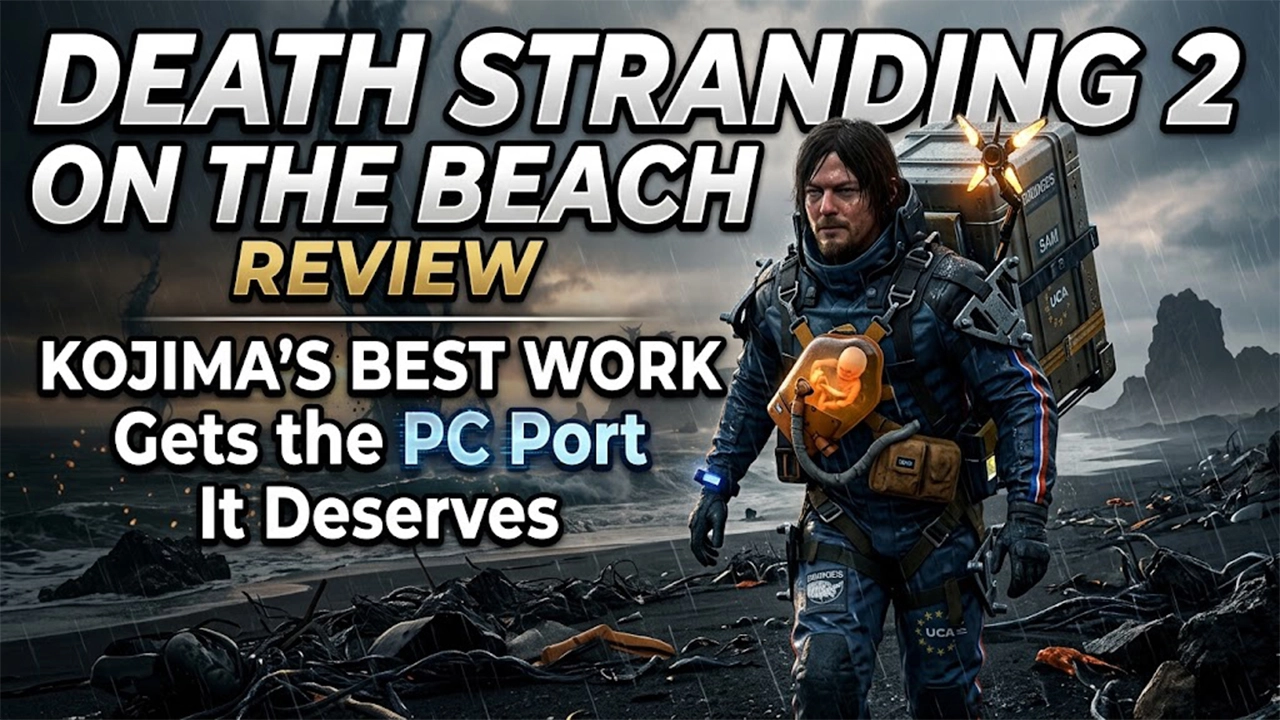
I’ll admit something upfront: I skipped this one on PS5 last year. Not because I didn’t want to play it, but because I was still processing how much the first Death Stranding messed with my head, in a good way, and I wasn’t ready to go back into that headspace yet. The PC release gave me the excuse I needed. I’m glad it did.
What You’re Actually Doing Here
If you’ve never played a Death Stranding game, the premise sounds almost absurd written down: you’re a courier named Sam Porter Bridges, carrying packages across a broken, isolated world, trying to reconnect scattered communities one delivery at a time. That’s it. That’s the core loop. No guns blazing through most of it, mostly just you, a mountain, and the very real question of whether you’re going to trip and lose your cargo down a ravine.
It shouldn’t work as well as it does. Somehow, it works incredibly well.
On the Beach keeps that foundation but smooths out almost every rough edge the original had. Vehicles handle better. You get useful weapons earlier instead of grinding through hours of pure traversal first. The material-gathering loop feels tighter, if a little more restrictive at times, which is really the only mechanical complaint I can level at it.
The Story Hits Harder Than I Expected
I won’t spoil anything here, because half the joy of a Kojima game is not knowing what’s coming next. What I’ll say is this: there’s a stretch in the back half of the game dealing with grief that genuinely stopped me from playing for a night. Not because it was bad. Because it landed too well, and I needed a minute.
Is the plot still a little opaque in places? Sure. Kojima has never been the guy for tight, economical storytelling, and this is no exception. But the emotional beats connect even when the plot mechanics get tangled, and that’s the part that actually matters here.
Longtime fans of the first game might find this one slightly easier overall, and a few reviewers have pointed out the same thing. If you came to Death Stranding specifically for its punishing traversal difficulty, know that On the Beach softens that edge a bit. The new “Into the Wilder” difficulty setting exists specifically to give that challenge back to anyone who wants it.
Now, the Part I Actually Care About: The PC Port
This is where the review earns its place in our Reviews section instead of just being another opinion piece about a good game.
Nixxes handled this port, the same studio behind excellent PC versions of Horizon Forbidden West and Ghost of Tsushima, and it shows. This is one of the cleaner PlayStation-to-PC transitions in recent memory. You get proper ultrawide support at both 21:9 and 32:9, which matters more than you’d think for a game this obsessed with scale and landscape.
On the upscaling front, everything’s here: DLSS, FSR 4.1, XeSS, and multi-frame generation, plus optional ray tracing for anyone with the hardware to spare. And here’s a detail that made me laugh when I found it: the PC version launched with gyro aiming support before the PS5 version got it. PlayStation players had to wait for a patch to get a feature PC players had from day one. That’s not a small thing if you’ve ever wanted more precise aim without a mouse.
Performance scaling has genuinely impressed reviewers across a wide spread of hardware, from fairly modest rigs up to systems running current-generation GPUs. If your PC has been sitting somewhere in the middle of the pack, this isn’t a game that’s going to lock you out of a good experience.
There’s also a new mechanic called “Trapped in a Strange Realm,” which lets you replay boss encounters on demand instead of hunting for a way back to them naturally. Small addition, genuinely useful if a specific fight is bothering you and you want another crack at it without a full replay.
The Multiplayer Layer Still Feels Like Magic
One thing that struck me replaying this on PC almost a year after its original launch: the asynchronous multiplayer has had time to actually build up. Other players’ bridges, ziplines, and roads are scattered across the map now, left behind from nearly a year of accumulated play. It punctures the isolation the game is clearly going for in places, but it also creates this strange, quiet sense of community with people you’ll never actually meet. Somebody built a zipline exactly where I needed one. I’ve never met them. I probably owe them something.
So, Should You Play It?
If you loved the first Death Stranding, yes, obviously, and you probably already know that. If you bounced off the original because the controls felt stiff or the pacing dragged early on, this sequel addresses a lot of that friction directly. And if you’re coming to this fresh on PC specifically, you’re getting arguably the best version of the game that exists right now.
My score: a genuine 9 out of 10. It loses a point purely for pacing stretches in the middle act that even Kojima fans will admit run a little long. Everything else here is close to a masterclass in what a AAA PC port should look like.
If you’re wondering whether your current rig can actually run this well, our PC building guide is a solid starting point for figuring out where your setup stands.