DDR4 vs DDR5 in 2026
RAM used to be the boring decision on a build sheet. Pick a reasonable speed, grab enough capacity, move on with your life. That calm has evaporated a bit over the past year, and not for a reason that has anything to do with gaming performance. It’s a supply chain fight happening several steps removed from your build, and it’s dragging your RAM prices along for the ride whether you like it or not.
Let’s deal with the elephant in the room first: prices have genuinely lost their minds
Before I get into DDR4 versus DDR5 on the actual merits, it’s worth naming the thing warping this entire conversation. Memory prices have climbed somewhere in the range of 300 to 500 percent since mid-2025 — and no, that’s not because DRAM suddenly got harder to manufacture. It’s because Samsung, SK Hynix, and Micron have been quietly redirecting production toward the HBM chips that power AI data centers, leaving a lot less capacity for the ordinary DDR4 and DDR5 kits people actually put in gaming PCs. A 32GB DDR4 kit that ran roughly $55 to $70 back in mid-2025 is now commonly listed somewhere between $220 and $350, depending on the retailer and how unlucky your timing is. DDR5 has it worse in absolute terms, with comparable 32GB kits climbing from the $80-to-$120 range up toward $300 to $500.
I’m leading with this because it genuinely changes advice that used to be simple. A year ago, “just grab DDR5, it’s not that much pricier” was a completely reasonable thing to say. Right now, DDR5 runs roughly 50 to 70 percent more per gigabyte than DDR4 in a lot of markets, and that’s wide enough that it’s actually worth stopping to ask whether you need it — not just defaulting to the newer standard because it sounds like the obvious upgrade.
What DDR5 actually brings to the table, once you cut past the marketing
To be fair to DDR5, this isn’t just a sticker refresh — the underlying architecture genuinely changed. Base clock speeds start around 4800MHz and scale well past 7200MHz on the enthusiast kits, compared to DDR4’s usual 2133-to-3600MHz range. Each module also splits into two independent 32-bit subchannels instead of one, which helps parallelism, and it runs at a lower 1.1V for better efficiency while it’s at it. On paper, a DDR5-5600 kit hands you something like 50 percent more raw bandwidth than a DDR4-3600 kit at the same capacity.
Here’s the catch, though, and it’s the one that actually matters: raw bandwidth on a spec sheet and actual frames per second in the games you play are two very different animals, and games have historically been stingy about rewarding extra memory bandwidth. A bigger number on the box doesn’t automatically become a bigger number on your monitor.
So what do the actual benchmarks show?
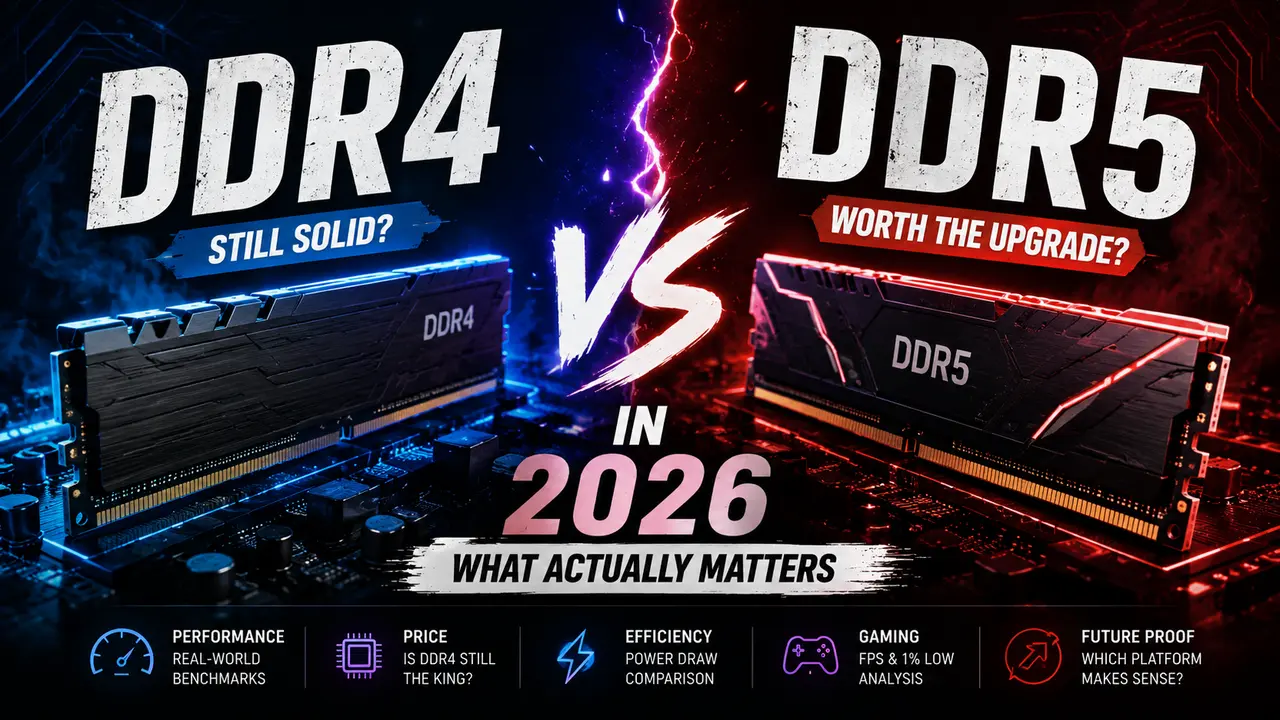
This is where I’d push back a little on anyone who tells you the gap is either huge or basically nothing, because the honest answer is “it depends enormously on what you’re actually playing.” Across most 2026 gaming benchmarks, DDR5-5600 and DDR4-3600 land remarkably close together – often within 2 to 5 percent of each other on average, and in genuinely CPU-bound titles that gap shrinks to something you’d need a frame counter running just to notice. Push your resolution up to 1440p or 4K and the story flattens out even more, since the GPU takes over as the bottleneck and memory generation stops mattering nearly as much.
But averages hide the interesting part, and this is the bit I find genuinely fascinating. In 1080p CPU-bound scenarios, and especially in open-world games leaning hard on background asset streaming, DDR5 can pull ahead by 8 to 15 percent – a gap you will actually feel if you’re chasing high frame rates in exactly those conditions. And then there’s the outlier that’s worth knowing by name, because it’s a little wild. Club386 built two nearly identical test rigs — same RTX 5070, same storage — differing only in platform: a Ryzen 7 9700X on DDR5-6000 against a Ryzen 5700X on DDR4. In Rainbow Six Siege X, a famously CPU-hungry esports title that barely taxes the GPU, the DDR4 rig ran 183 to 209 FPS on medium settings. The DDR5 rig, same graphics card, same everything else, hit 425 to 491 FPS. That’s not a rounding error. That’s basically a different game, and it’s the clearest illustration I’ve seen of why “it depends on the title” isn’t a dodge — it’s genuinely the correct answer here.
For workstation work — Blender renders, DaVinci Resolve exports, anything that actually leans on bandwidth – DDR5 delivers a steadier 10 to 20 percent improvement, because those workloads use the extra bandwidth DDR5 offers instead of getting stopped by some other bottleneck first, the way most games do.
Your platform probably already made this decision for you
Here’s the part that quietly simplifies things for a lot of builders. AMD’s AM5 socket — Ryzen 7000, 8000, and 9000 series — is DDR5-only, no exceptions, no DDR4 path available at all. Intel’s Arrow Lake and Arrow Lake Refresh on LGA1851 are the same deal. Building fresh on either? The DDR4-versus-DDR5 debate is purely academic for you. You’re buying DDR5 regardless of price, because there’s genuinely no slot to put DDR4 into.
Where the choice actually stays open is Intel’s 12th-through-14th-gen LGA1700 platform, which still comes in both DDR4 and DDR5 motherboard flavors — you pick one when you buy the board, and you’re locked in after that. Building on that platform and care more about your wallet than squeezing every last frame out of CPU-bound titles? A DDR4 board paired with a DDR4-3600 kit is still a completely legitimate, meaningfully cheaper road to take in this market.
What speed should you actually buy
For DDR4, the sweet spot sits around 3200 to 3600MHz. Push past 3600 and you run straight into diminishing returns — you’re paying noticeably more per gigabyte for gains that mostly don’t show up in real gameplay anymore, no matter how good the number looks on the box.
For DDR5, 5600 to 6000MHz is where price-to-performance balances out best right now, and if you’re specifically on Ryzen 7000-series or newer, DDR5-6000 has an extra reason going for it: it lines up 1:1 with the platform’s Infinity Fabric clock, which keeps latency tighter than speeds falling outside that ratio. Going faster still, to DDR5-6400 or beyond, does give you a genuinely noticeable extra boost in both gaming and content work — but you’re paying dearly for it, and kits at that tier are getting hit hardest by the current shortage pricing.
So, honestly – DDR4 or DDR5?
If you’re building fresh on AM5 or a current Intel platform that only does DDR5, there’s nothing to decide. Grab a DDR5-5600 to 6000 kit and get on with your build. If you’re upgrading an existing AM4 or older Intel DDR4 system, or you’re building fresh on LGA1700 and cost is a real constraint rather than a footnote, DDR4 at 3200 to 3600MHz remains a genuinely sound, noticeably cheaper choice in 2026. Outside of specific CPU-bound esports titles and content-creation work, you probably won’t feel the difference day to day.
One thing I’d steer you away from, though: don’t jump platforms purely to chase DDR5’s performance ceiling if your current DDR4 setup is running fine. Going from an AM4 or older LGA1700 DDR4 build to a full DDR5 platform means a new motherboard, and often a new CPU too – easily $300 to $500 on top of whatever the RAM itself costs. At today’s inflated memory prices, that’s a steep bill for a performance gain you’ll mostly only notice in a narrow slice of games.
AT THE END
DDR5 is the better technology. Nobody’s arguing otherwise. But “better” and “worth the current price gap for what you actually do with your PC” are two separate questions, and in a market where memory prices have tripled or quadrupled in a year, the second one deserves an honest answer before you hand over your card. Match your RAM to your platform, aim for the sweet-spot speed instead of the flashiest number on the shelf, and don’t let anyone talk you into a DDR5 upgrade your current system genuinely doesn’t need.