When will RAM prices go down? RAM Price Predictions: What the Actual Forecasters Are Saying About When This Ends
I’ve written about the RAM shortage a few times now on this site, mostly in passing, as context for why a build that should cost $1,200 now costs $1,500. This piece is different. I wanted to actually sit down with what the analysts, the manufacturers, and the market data are saying about where this goes next, rather than just noting that prices are bad and moving on. What I found is messier, and more interesting, than the “prices are up, sorry” framing usually allows for.
Where things actually stand right now
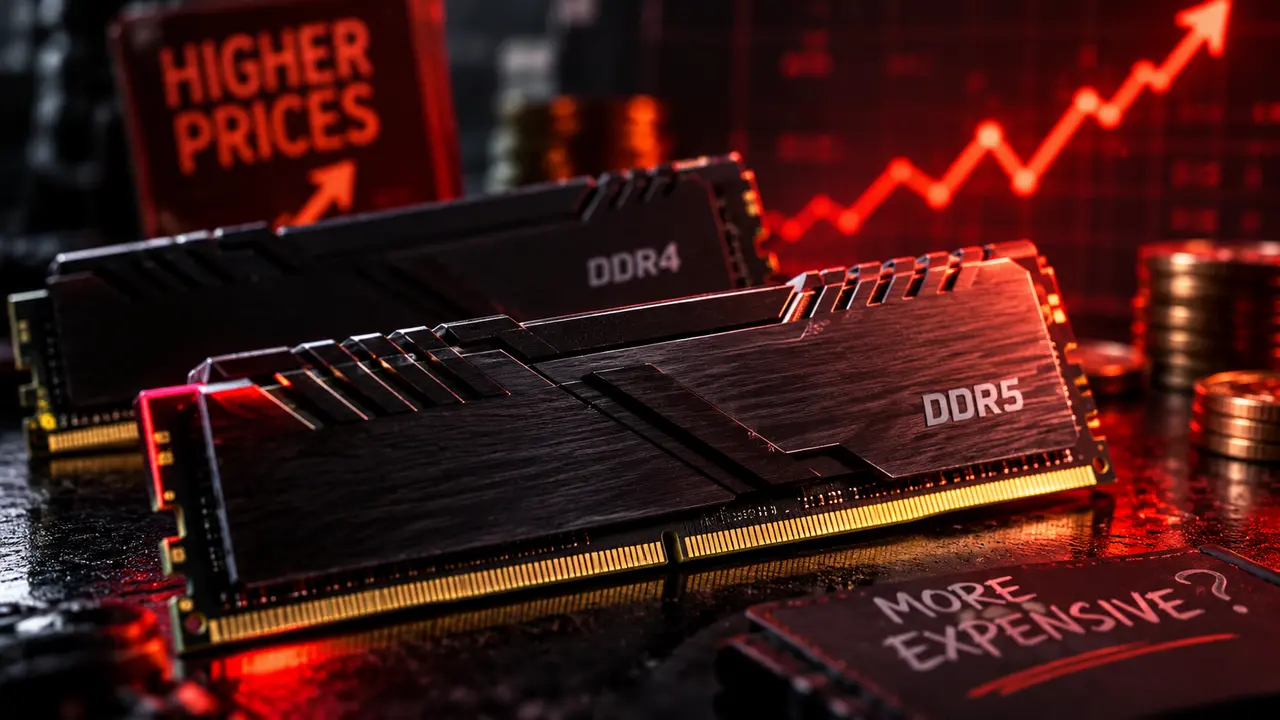
Let’s ground this in real numbers first, because the scale of what’s happened this year is easy to state abstractly and hard to actually absorb. A 32GB DDR5-6000 kit that sold for roughly $80 to $90 in mid-2025 was running somewhere between $400 and $500 by early September 2026, depending on the retailer and the exact spec. That’s not a price increase in the way we normally use the term. That’s a 400-to-500-percent jump in about a year, and tracking sites watching this daily have noted the climb hasn’t been a single spike and plateau — it’s been a series of quarterly jumps, each one landing on top of the last.
TrendForce, the industry’s most-cited memory market research firm, documented conventional DRAM contract prices rising 90 to 95 percent quarter-over-quarter in Q1 2026 alone. Q2 brought another 58 to 63 percent on top of that. By the time TrendForce issued its Q3 guidance, the forecast had moderated to 13 to 18 percent — still a real increase, just a smaller one than the previous two quarters. That deceleration matters, and I’ll come back to why in a moment, because it’s genuinely one of the more interesting signals in this whole story.
Why this happened, in one paragraph
You’ve probably read this part before, on this site or elsewhere, but it’s worth stating plainly once: Samsung, SK Hynix, and Micron together account for the overwhelming majority of global DRAM production, and all three have been redirecting fab capacity toward high-bandwidth memory, the specialized chips that feed AI accelerators, because HBM commands dramatically higher margins than the DDR5 sitting in your gaming PC. Analysts estimate AI data centers now absorb something like 70 percent of global memory output. Every wafer that goes toward an HBM stack is a wafer that isn’t making consumer DRAM, and that reallocation is the entire root of what’s happened to RAM pricing this year.
What the forecasters are actually predicting for 2027 and beyond
This is where it gets genuinely useful to look past the headline “prices are up” framing and see what specific institutions are actually committing to on the record.
Goldman Sachs has forecast that Samsung’s average selling prices for memory will climb another 27 percent in 2027, on top of everything that’s already happened. Gartner, working from a different angle, projects a 3.6 percent global undersupply persisting through all of 2027 — a smaller-sounding number, but one that Gartner explicitly frames as meaning real pricing relief isn’t realistically on the table until late 2027 or 2028 at the earliest.
The most striking comment on the record so far, though, came directly from SK Hynix’s own CEO, who told Reuters in July that 2027 would be the worst year in the memory industry’s history for supply, and that demand would likely keep exceeding capacity even beyond 2030. That’s not an analyst modeling a scenario from outside the industry. That’s the head of one of the three companies that controls global DRAM supply, on the record, describing his own market as structurally short for the rest of the decade.
Samsung’s own investor guidance, delivered in late July, struck a similar note without the dramatic framing — the company told investors it expects the memory market to remain undersupplied through the second half of 2026, driven by server DRAM, enterprise SSD, and HBM demand all outpacing available supply simultaneously.
The capacity expansion story, and why it won’t help as fast as the dollar figures suggest
Here’s the part I think gets genuinely underreported in a lot of shorter coverage of this topic: yes, enormous amounts of money are being poured into new fab capacity. South Korea’s government stood alongside Samsung and SK Hynix in mid-2026 to announce what’s been described as the largest industrial investment plan in the country’s history — something in the range of $550 billion aimed at new DRAM and NAND capacity, on top of separate multi-billion-dollar commitments from Micron for fabs in Idaho, New York, and Singapore.
The problem isn’t the money. It’s the physics and logistics of building a semiconductor fab, which simply cannot be compressed no matter how large the check is. SK Hynix’s own board approved roughly $38 billion for two new plants in August 2026, and the disclosed timeline is worth sitting with: the HBM and next-generation DRAM facility doesn’t even break ground until July 2027, with its first cleanroom not opening until June 2029 — and a cleanroom opening is still a step before equipment installation, let alone actual volume shipments. That’s the gap between “capacity has been approved” and “capacity actually exists,” and it’s measured in years, not quarters.
Even capacity that does come online sooner tends to be earmarked for the highest-margin products first. Micron’s HBM output, for instance, has reportedly been sold out through the end of 2026 already, via signed contracts with AI chip customers — meaning even new supply coming from an existing, already-running fab doesn’t necessarily flow toward the consumer DDR5 market that gaming PCs actually need.
Is this actually a bubble? The skeptics make a real case
I don’t want to present this as a one-sided story, because there’s a genuine, well-reasoned skeptical case being made by people who watch this market for a living, and it deserves real space here rather than a dismissive footnote.
The memory industry has a well-documented history of exactly this pattern: prices spike, manufacturers over-invest in response, a wave of new capacity lands all at once, supply overshoots demand, and prices collapse hard. The 2017-2018 “supercycle” is the most-cited recent example — DRAM prices rose roughly 90 percent over that cycle, and when it broke, Micron’s stock fell from around $64 to $28 in the aftermath. Multiple analysts covering the current cycle have explicitly invoked that memory, cautioning that every previous “this time is different” narrative in this industry has eventually been proven wrong.
There’s a specific, more technical version of the skeptic argument worth understanding too: some of the current demand may be inflated by buyers stockpiling out of fear of future shortages and price increases, rather than reflecting genuine end-use need. If a meaningful share of 2026’s DRAM purchases turns out to be precautionary hoarding rather than immediate consumption, an unwinding of those inventories could create a glut faster than the capacity-timeline story alone would suggest — essentially a self-inflicted correction layered on top of the supply-side one.
And that Q3 2026 deceleration in TrendForce’s contract price forecast — from 90-plus percent quarterly growth down to the mid-teens — is exactly the kind of leading indicator market analysts watch closely. One detailed industry analysis I came across noted that in the 2018 cycle, momentum in contract pricing peaked two to four quarters before the actual price level topped out. If that pattern holds this time, a decelerating rate of increase now doesn’t mean prices are dropping yet, but it could be an early signal that the cycle’s peak is closer than the more dramatic “worst year in history” framing suggests.
The case that this cycle is genuinely different
Set against that skepticism, there’s a real structural argument for why this cycle might not follow the old boom-bust script, and it’s not just industry marketing spin. Previous DRAM cycles were driven primarily by demand spikes — a new smartphone cycle, a wave of PC upgrades, something that eventually satiated itself. What’s happening now is different in kind, not just scale: AI servers reportedly use something like eight times more DRAM per unit than a traditional server, meaning the AI buildout isn’t just adding more customers to the existing market, it’s fundamentally raising how much memory each customer needs. That’s a structural shift in demand intensity, not a temporary spike that resolves once everyone’s upgraded.
Some analysts have reached for a different historical comparison entirely — not the roughly two-year 2017-2018 supercycle, but the sustained 1990 to 1995 DRAM shortage driven by the rise of Windows and PC-era computing, a shortage that lasted the better part of six years rather than resolving quickly. If the AI buildout genuinely plays out on that kind of timeline, the entire premise of “wait for the correction” starts to look less reliable as advice.
So, when does this actually end?
Weighing all of this together, here’s roughly where the range of credible forecasts currently sits: the earliest plausible window for a real, sustained decline in retail RAM prices is late 2027 to 2028, tied to when the first meaningful wave of new fab capacity from Samsung and SK Hynix is actually scheduled to come online. Some forecasts, including SK Hynix’s own, push meaningfully past that, suggesting supply-demand balance may not fully normalize until sometime after 2030. Nothing in the current data supports the idea of a sharp price drop before the end of 2026 — every forecaster on record, bull or skeptic, agrees prices are still climbing right now, just at a slower rate than earlier in the year.
I’d hold that timeline loosely rather than treat it as settled fact, for what it’s worth. Forecasts on this specific question have already moved meaningfully within 2026 alone — earlier TrendForce projections that once pointed toward a 2025 price decline turned out to be badly wrong once the AI-driven demand surge actually hit. The people closest to this market have been surprised by it before, in both directions, and there’s no strong reason to assume today’s projections are the final word either.
What this actually means if you’re buying RAM right now
If you need memory today for a build you’re actually completing, waiting for a crash that every current forecast places at minimum a year away, and possibly several years away, isn’t a strategy — it’s a bet against the entire current consensus, made by people whose job is not actually forecasting memory markets. If your platform supports DDR4 and your performance needs don’t specifically demand DDR5, that remains the one genuinely available lever for spending meaningfully less right now, since DDR4 has been caught up in the same shortage but from a lower, more forgiving starting price.
If you can delay a purchase without consequence, keeping an eye on that TrendForce quarterly deceleration trend is worth doing — a continued slowing in the rate of increase, quarter over quarter, would be the first real signal that the cycle’s momentum is finally turning, even before prices themselves start actually falling.
At the end
The honest answer to “when will RAM prices go down” is that nobody currently on record — not TrendForce, not Goldman Sachs, not the CEO of one of the three companies that controls global supply — is predicting relief before late 2027 at the absolute earliest, and several credible voices are pointing considerably further out than that. There’s a real, coherent skeptic case that this is still a cyclical market destined for the same boom-bust pattern it’s followed for three decades, and a real, coherent case that AI has permanently changed how much memory the world needs in a way that breaks the old pattern entirely. Both arguments are being made by serious people looking at the same data. If you’re building a PC in the next year, plan around today’s prices actually being close to what you’ll pay, and treat any pleasant surprise as exactly that — a surprise, not something the current evidence was actually promising you.