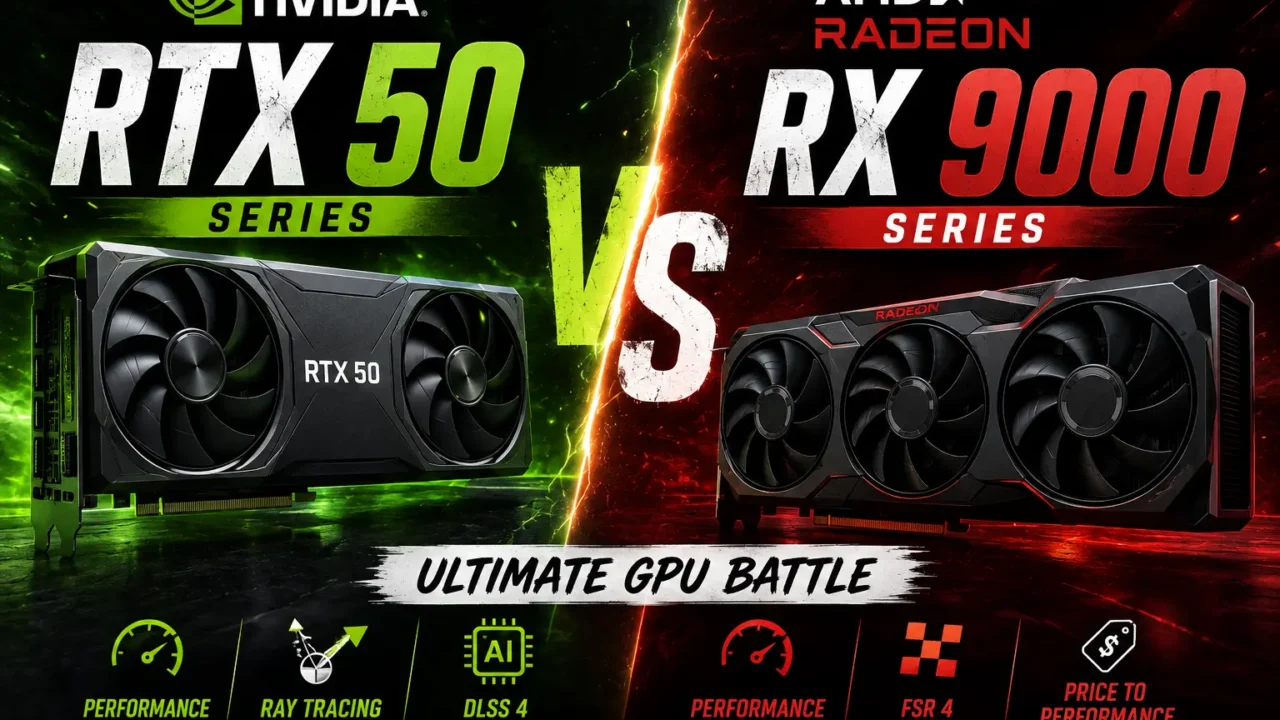
NVIDIA RTX 50 Series vs AMD Radeon RX 9000 Series: Which GPU Is Better for Gaming?
Buying a graphics card has become more complicated than simply asking which GPU is faster.
NVIDIA’s GeForce RTX 50 Series brings the Blackwell architecture, stronger ray tracing hardware, DLSS 4 and newer AI features. AMD’s Radeon RX 9000 Series takes a different approach with RDNA 4, more traditional rasterization performance, 16GB options in the RX 9070 family, and AMD’s newer FSR technology.
So which one should you buy?
The answer depends on how you play.
If you mainly care about traditional rasterized gaming, AMD has some very competitive cards. If ray tracing, AI features, content creation, and upscaling quality are high on your list, NVIDIA becomes much harder to ignore.
And then there is price.
That can completely change the recommendation.
Let’s compare the two GPU families and look at where each one makes the most sense.
RTX 50 Series vs RX 9000 Series at a Glance
NVIDIA’s RTX 50 Series is based on the Blackwell architecture. The current desktop lineup includes the RTX 5090, RTX 5080, RTX 5070 Ti, RTX 5070, RTX 5060 Ti, RTX 5060 and RTX 5050. NVIDIA combines the new architecture with fifth-generation Tensor Cores, fourth-generation RT Cores, DLSS and neural rendering features.
AMD’s RX 9000 Series is based on RDNA 4. The lineup includes cards such as the RX 9070 XT, RX 9070, RX 9070 GRE and RX 9060 XT. AMD also introduced hardware-accelerated AI features and third-generation ray-tracing accelerators with this generation.
The two companies are targeting many of the same gamers, but they are not taking exactly the same path.
| Feature | NVIDIA RTX 50 Series | AMD RX 9000 Series |
|---|---|---|
| Architecture | Blackwell | RDNA 4 |
| Upscaling | DLSS | FSR |
| Frame generation | DLSS Multi Frame Generation | FSR Frame Generation / newer FSR technologies |
| Ray tracing | Very strong | Much improved |
| AI hardware | Tensor Cores | AI Accelerators |
| Memory | GDDR7 on RTX 50 | GDDR6 on RX 9000 |
| High-end focus | RTX 5090 / 5080 | RX 9070 XT |
| Typical strength | RT, AI, DLSS | Rasterization, value |
| Creator ecosystem | Strong | Improving |
The important thing is not to look at this table and immediately pick a winner.
You need to look at what you actually do with your PC.
RTX 50 Series: NVIDIA’s Biggest Advantages
The RTX 50 Series has one major advantage that goes beyond traditional GPU horsepower.
NVIDIA has built a huge software and AI ecosystem around its graphics cards.
The Blackwell architecture includes fifth-generation Tensor Cores and fourth-generation RT Cores. NVIDIA also introduced new neural rendering capabilities and DLSS 4 with the RTX 50 generation.
That matters when you play games that support these technologies.
DLSS Is a Major Part of the RTX Experience
DLSS has become one of the biggest reasons gamers choose NVIDIA.
Instead of rendering every frame entirely at native resolution, supported games can render at a lower internal resolution and use AI-based reconstruction to produce a higher-resolution image.
The RTX 50 Series takes this further with Multi Frame Generation.
NVIDIA’s original DLSS 4 implementation introduced the ability to generate multiple additional frames between traditionally rendered frames. NVIDIA says DLSS 4 can generate up to three additional frames per rendered frame in supported modes.
That can produce a very high displayed frame rate.
But there is an important detail.
Generated frames are not the same thing as traditionally rendered frames.
If your GPU is struggling to produce a playable base frame rate, turning on frame generation does not magically eliminate the underlying performance problem.
You still want strong native or upscaled rendering performance first.
That’s why I would treat DLSS and Multi Frame Generation as tools that improve an already capable system rather than replacements for GPU horsepower.
AMD’s Biggest Advantage: Rasterization and Value
AMD’s RX 9000 Series is very interesting if you care mostly about conventional rendering.
The RX 9070 XT is a good example.
AMD gives it 64 Compute Units, 16GB of GDDR6 memory, a 256-bit memory interface, up to 640 GB/s of memory bandwidth and a 304W typical board power rating. AMD lists a $599 launch price for the card.
That’s a lot of hardware for the price.
Independent testing also showed why the RX 9070 XT became so competitive. TechRadar found it close to the RTX 4080 in overall gaming performance in its test suite and noted that it was about 7% behind the RTX 5070 Ti at 1440p and about 8% behind it at 4K in that testing.
The interesting part is the original pricing.
The RX 9070 XT launched at $599, while the RTX 5070 Ti launched at $749.
That’s a significant difference.
If you are buying a gaming GPU with your own money, price matters just as much as the benchmark chart.
RTX 5070 Ti vs RX 9070 XT
This is probably one of the most interesting comparisons in the entire generation.
The RTX 5070 Ti and RX 9070 XT target a similar type of buyer.
Both are strong 1440p cards.
Both can handle 4K gaming.
Both have 16GB of VRAM.
But they take different approaches.
The RTX 5070 Ti has faster GDDR7 memory and stronger AI hardware. The RX 9070 XT uses GDDR6 but offers 16GB of memory and strong traditional rendering performance. TechRadar’s comparison found the RTX 5070 Ti slightly ahead overall, while the RX 9070 XT offered a stronger value proposition at its lower launch price.
So which would I choose?
If the two cards cost roughly the same, I would lean toward the RTX 5070 Ti for the broader feature set.
If the RX 9070 XT is substantially cheaper, the AMD card becomes very attractive.
That’s the key.
Don’t ignore the price difference just because one GPU wins a benchmark by a few percent.
RTX 5070 vs RX 9070
The same story appears one level down.
The RX 9070 has 56 Compute Units, 16GB of GDDR6 and a 220W typical board power rating. AMD launched it at $549.
The RTX 5070 is another strong 1440p option.
In TechRadar’s testing, the two cards were extremely close in gaming. At 1440p, the RX 9070 averaged 114 FPS compared with 115 FPS for the RTX 5070 in the tested suite. At 4K, the RX 9070 actually had a small average FPS advantage in that test set.
That’s a good example of why you should not judge a GPU by its name alone.
The RTX 5070 isn’t automatically faster because it is NVIDIA.
The RX 9070 isn’t automatically faster because it has more VRAM.
The actual result depends on the game.
Ray Tracing: NVIDIA Still Has the Edge
This is one area where NVIDIA remains the safer choice.
AMD has made significant progress with RDNA 4.
The RX 9000 Series includes improved ray accelerators, and AMD says the generation delivers better ray-tracing performance than previous Radeon cards.
But NVIDIA’s RT hardware and software ecosystem remain very strong.
If you play games with heavy ray tracing or path tracing, RTX cards are generally the better option.
This becomes even more important in games where ray tracing is a major part of the visual design.
Think about titles with:
- Full path tracing
- Heavy global illumination
- Ray-traced reflections
- Ray-traced shadows
- Complex lighting
- Neural rendering
If you are the kind of gamer who turns every graphics option to maximum and enables ray tracing first, NVIDIA makes more sense.
AMD is much closer than it used to be.
But “closer” doesn’t mean “identical.”
DLSS vs FSR
This is another major difference.
NVIDIA has DLSS.
AMD has FSR.
Both are designed to increase performance while maintaining image quality.
The difference is in how the technologies work and how widely they are implemented.
NVIDIA’s RTX hardware provides dedicated Tensor Cores for its AI workloads, while AMD’s RX 9000 cards use dedicated AI accelerators for RDNA 4 features.
AMD’s latest FSR technology has also moved further toward machine-learning-based processing.
AMD says its newer FSR “Redstone” technology uses ML-based features and supports RX 9000 Series hardware for these advanced capabilities.
So AMD is not standing still.
This is important.
A few years ago, the conversation around upscaling was much more one-sided.
Today, AMD has a much more serious answer to NVIDIA.
Still, if I were buying a GPU primarily for the best overall upscaling and frame-generation ecosystem, I would currently give NVIDIA the advantage.
What About Frame Generation?
Both companies now offer frame-generation technologies.
NVIDIA’s RTX 50 Series takes it further with Multi Frame Generation.
AMD also has frame generation through its FSR ecosystem, with newer FSR technologies adding more ML-based features to supported Radeon hardware.
This creates an interesting situation.
You can have a GPU rendering 70 traditional frames per second and then display a much higher reported frame rate after frame generation.
That can make supported games feel smoother.
But don’t make the mistake of comparing a GPU running native rendering against another GPU using multiple generated frames and calling the numbers equivalent.
They aren’t.
For a fair comparison, look at the base rendered performance first.
Then look at what the respective upscaling and frame-generation technologies add.
VRAM: AMD Has Some Strong Options
VRAM has become increasingly important for modern gaming.
Large texture packs and high-resolution assets can consume a lot of memory.
The RX 9070 XT and RX 9070 both have 16GB of GDDR6.
That’s useful for 1440p and 4K gaming.
NVIDIA’s lineup varies considerably.
The RTX 5090 has 32GB of GDDR7, while the RTX 5080 has 16GB. Other RTX 50 models have different memory configurations. NVIDIA’s current lineup spans from the RTX 5090 down through the RTX 5050.
So you cannot really say “AMD has more VRAM” or “NVIDIA has more VRAM” as a blanket statement.
You need to compare the specific cards.
For example, RTX 5090 versus RX 9070 XT isn’t even a sensible performance-class comparison.
The RTX 5090 is in another category.
4K Gaming: Which Brand Makes More Sense?
If you’re targeting 4K, both companies have capable hardware.
NVIDIA has the clear performance leader in the RTX 5090.
The card comes with 32GB of GDDR7 and is designed for extreme gaming and creative workloads. NVIDIA positions it as its flagship GeForce GPU.
AMD does not currently have an RX 9000 card that directly occupies the same extreme performance class.
Instead, the RX 9070 XT is positioned much closer to the high-performance mainstream and enthusiast market.
That makes AMD’s value proposition different.
If you want the fastest possible gaming GPU, NVIDIA is the obvious direction.
If you want strong 4K performance without spending flagship money, AMD becomes much more interesting.
TechRadar’s testing found the RX 9070 XT around 3.5% behind the RTX 4080 at 4K and about 8% behind the RTX 5070 Ti in its test suite.
That’s impressive for a $599 launch-price GPU.
1440p Gaming: This Is Where AMD Gets Interesting
For many PC gamers, 1440p is the sweet spot.
You get a sharper image than 1080p without requiring the same GPU horsepower as 4K.
This is also where the RX 9000 Series becomes very competitive.
The RX 9070 and RX 9070 XT are both capable 1440p GPUs.
The RTX 5070 and RTX 5070 Ti are also excellent choices.
At this resolution, I would pay close attention to the price of the specific models available to you.
A $100 difference can change the recommendation.
If two cards deliver similar FPS and one costs noticeably less, the cheaper card gives you more room in your budget for a better CPU, SSD, monitor, or power supply.
1080p Gaming: Don’t Overspend
If you’re gaming at 1080p, you probably don’t need an RTX 5090.
It sounds obvious, but people still buy much more GPU than their monitor requires.
At 1080p, CPU performance can become increasingly important at high refresh rates.
A 240Hz competitive gaming setup is a different workload from a 4K single-player gaming PC.
For this market, cards such as the RTX 5060, RTX 5060 Ti and RX 9060 XT are much more relevant.
AMD’s RX 9060 XT comes in both 8GB and 16GB versions, while NVIDIA offers RTX 5060 Ti variants with different memory capacities. AMD’s current specifications list the RX 9060 XT 16GB with 160W typical board power and a 128-bit memory interface.
For a new gaming PC, I would strongly consider the 16GB option if the price difference is reasonable.
Games are getting heavier.
Content Creation: NVIDIA Has the Advantage
If gaming is only half of what you do, the decision changes.
NVIDIA has a mature ecosystem around CUDA, Studio drivers, NVENC, Broadcast, AI tools and other creator-focused technologies.
The RTX 50 Series also includes a newer ninth-generation encoder according to NVIDIA’s current product information.
AMD has improved its media engine and encoder capabilities with RDNA 4.
AMD’s RX 9070 XT supports H.264 and H.265 encoding as well as AV1 encode and decode.
That’s useful for streaming and video work.
But software compatibility matters.
If the applications you use rely heavily on CUDA or NVIDIA-specific acceleration, buying an AMD card just because it has strong gaming performance may not be the best move.
Before buying, check the applications you actually use.
Blender?
Premiere Pro?
DaVinci Resolve?
AI tools?
3D rendering?
The answer can change depending on the workload.
Power Consumption Matters Too
Don’t forget the power supply.
The RX 9070 XT has a 304W typical board power rating and AMD recommends a 750W PSU.
The exact power requirements vary across the RTX 50 lineup.
A flagship RTX 5090 is obviously going to demand much more power than an RTX 5060.
This affects more than your electricity bill.
It affects:
- PSU requirements
- Case airflow
- Cooling
- Noise
- Heat inside the case
- Upgrade options
If you’re building a compact gaming PC, power efficiency becomes even more important.
A slightly slower GPU that fits your thermal and power limits can be a better choice than a faster card that turns your small case into a space heater.
What About Current GPU Prices?
This is where things get tricky in 2026.
Launch MSRP is useful, but it isn’t the same as the price you actually pay.
Current market conditions have pushed some RTX 50-series cards considerably above their earlier pricing. Tom’s Hardware reported in August 2026 that median U.S. prices for several RTX 50-series models had risen sharply, including a 36% increase for the RTX 5070 and a 39% increase for the RTX 5060 Ti 16GB compared with June prices.
That makes the AMD comparison even more important.
You should check the actual price of both brands before buying.
A GPU that was the better deal at launch may not be the better deal today.
This is one reason I don’t like absolute statements such as “NVIDIA is better” or “AMD is better.”
The market changes.
Prices change.
Drivers change.
Games change.
NVIDIA RTX 50 Series vs AMD RX 9000 Series: Who Wins?
There isn’t one winner for every gamer.
Here’s how I would break it down.
Choose NVIDIA if you care about:
- Strong ray tracing
- Path tracing
- DLSS
- Multi Frame Generation
- AI features
- CUDA
- Creative applications
- NVIDIA Broadcast
- Strong creator software support
- Maximum flagship performance
The RTX 5090 is also in a class of its own within these two generations if you simply want the highest-end GeForce gaming performance.
Choose AMD if you care about:
- Strong rasterized gaming
- Competitive pricing
- 16GB VRAM on RX 9070-class cards
- 1440p gaming
- 4K value
- Open and broadly supported technologies
- Getting more traditional GPU performance for your money
The RX 9070 XT is a particularly strong example of AMD’s approach. Its $599 launch price and strong 1440p/4K performance made it one of the more interesting value options of the generation.
RTX 50 Series vs RX 9000 Series: My Recommendation
If I were building a gaming PC today, I wouldn’t start by choosing a brand.
I’d start with the games I play.
If most of your library consists of competitive games, open-world titles and traditional rasterized workloads, look closely at AMD.
If you play heavily ray-traced games, care about DLSS, or use your PC for creative work, NVIDIA deserves serious consideration.
And if you want the absolute highest-end GPU available in this comparison, the RTX 5090 is the obvious choice.
But you don’t need a flagship GPU to have a great gaming PC.
For most people, the interesting battle is lower down the stack.
RX 9070 XT vs RTX 5070 Ti.
RX 9070 vs RTX 5070.
RX 9060 XT vs RTX 5060 Ti.
Those are the comparisons where price, VRAM, ray tracing, upscaling and actual game performance can make the decision difficult.
Final Verdict
So, NVIDIA RTX 50 Series vs AMD RX 9000 Series—which is better?
If you want the most complete feature set, NVIDIA has the stronger overall platform.
Blackwell brings powerful ray tracing hardware, Tensor Cores, DLSS, Multi Frame Generation and a large software ecosystem.
If you care primarily about traditional gaming performance and value, AMD’s RX 9000 Series deserves a lot of attention.
The RX 9070 XT is a good example. It offers 16GB of VRAM, strong 1440p and 4K performance, and a $599 launch MSRP that made it particularly competitive against the RTX 5070 Ti.
So don’t buy based on the logo.
Look at the game benchmarks.
Look at the features you will actually use.
Look at VRAM.
Look at power consumption.
Most importantly, look at the price you can actually pay today.
If an RX 9070 XT is $100–$200 cheaper than an RTX 5070 Ti and you mainly play rasterized games, AMD can be the smarter purchase.
If the prices are close and you care about ray tracing, DLSS, AI features or creative applications, I’d lean toward NVIDIA.
That’s the real answer.
There is no universal winner. The better GPU is the one that matches your games, monitor, workload and budget.