Why You Can’t Buy a New Graphics Card This Year (And It Has Nothing to Do With Gamers)
If you’ve been holding off on a GPU upgrade because “the next generation is probably close,” I’ve got some bad news. There isn’t one. Not this year, anyway — and if you follow the supply chain reporting closely, maybe not for a while after that either.
For the first time in almost three decades, Nvidia looks set to go an entire calendar year without releasing a new gaming GPU architecture. That streak stretches back to the original GeForce 256 in October 1999. It survived the dot-com crash, the 2008 financial meltdown, the crypto mining booms and busts, a global pandemic. What finally broke it wasn’t a recession or a competitor. It was AI.
The memory chips just aren’t there
Here’s the part that surprised me when I first dug into this: the shortage isn’t really about GPUs. It’s about memory. Samsung, SK Hynix, and Micron have reportedly committed most of their 2026 HBM (high-bandwidth memory) output to AI data center customers, the same companies building out the server farms behind large language models. That leaves precious little capacity for the GDDR7 chips that go into consumer graphics cards.
The fallout has been ugly. Nvidia reportedly shelved its entire RTX 50 Super refresh back in December 2025 — including a completed 24GB RTX 5080 Super design that was apparently ready to ship — and redirected that memory supply toward AI and data-center products instead. The reporting first surfaced through The Information and has since been corroborated by outlets including PCWorld, TrendForce, and PC Gamer. The next-gen RTX 60-series, built on Nvidia’s Rubin platform, has reportedly slipped from a rumored late-2027 launch all the way to 2028.
It gets more granular than just “no new cards,” too. The RTX 5060 has apparently been pulled from retail entirely, and RTX 50-series production overall has been cut somewhere in the range of 15 to 20 percent through at least the third quarter of 2026. Nvidia hasn’t fully confirmed the skip outright, but the company did acknowledge memory supply constraints in a statement to Tom’s Hardware over the summer, which is about as close to a confirmation as these things usually get before someone in PR finally says the quiet part loud.
I’ll be honest, my first reaction reading through all this was a bit of “sure, sure, another rumor mill spinning out of control.” But when you see the same numbers show up independently across TrendForce, PCWorld, and Moore’s Law Is Dead, that’s not noise. That’s a pattern.
So what does that actually mean for prices?
Nothing good, unfortunately. Basic supply and demand: when a manufacturer ships fewer units into a market where nobody’s demand went away, prices don’t soften — they harden. The RTX 5090 is the poster child here. It launched at $1,999, which already felt steep, but it’s reportedly been trading well above $3,000 at multiple retailers, with some analyst forecasts putting it near $5,000 later this year if AI-driven demand for high-VRAM cards keeps climbing. Even older, legacy hardware like the RTX A6000 is reportedly seeing renewed demand as buyers look for anything they can actually get their hands on.
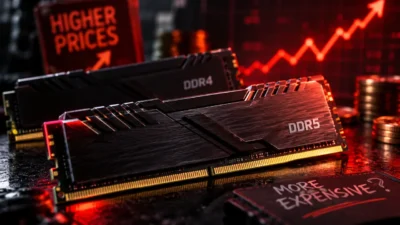
It’s not just top-shelf cards, either. Analysts have warned that sustained memory and component constraints could push overall consumer PC prices up by as much as 20 percent through 2026, which means the pain isn’t confined to the GPU line item on your build sheet — RAM and complete prebuilt systems are catching some of it too.
Why Nvidia doesn’t seem all that worried
Here’s the uncomfortable truth for anyone who grew up thinking of Nvidia as fundamentally a gaming company: it isn’t, anymore. Not really. Gaming reportedly accounted for somewhere around 11 percent of Nvidia’s revenue in its most recent fiscal year, and that share keeps shrinking as the AI side of the business balloons. When a memory shortage forces a company to choose between selling chips to enterprise customers at AI-driven margins or selling them to gamers at consumer prices, that’s not really a hard call from a shareholder’s perspective. It’s a rational business decision. It’s just one that happens to leave PC gamers holding the bag.
There’s a decent amount of dark humor floating around online about this — one post I came across joked that Nvidia is “cutting GeForce supply by 40% to feed the AI beast” and that “your gaming rig is now second priority to the data center.” Blunt, but not exactly wrong.
What I’d actually do about it
If you’ve got a working card and no urgent need, I don’t think this is a moment to panic. A few voices in the enthusiast press have made a fair point: we’ve barely scratched the surface of what the current RTX 50-series and RX 9000-series cards can actually do, since game engines and driver features take a while to catch up to new hardware anyway. Waiting isn’t necessarily losing.
But if you’ve been telling yourself “prices will come back down soon,” it’s worth adjusting that expectation. You’re not waiting for a price correction. You’re waiting for a new hardware generation, and that’s shaping up to be a 2027-or-later story, with the earliest meaningful supply relief tied to new HBM fab capacity coming online around 2027 to 2028 — and even that will get partially absorbed by whatever the next data-center chip generation needs.
My honest read: if you need to build or upgrade now, buy for the resolution and frame rate you’re actually chasing today, not the one you’re afraid of missing out on next year. The “next year” you’re picturing keeps sliding further away.
We’ll be tracking pricing and availability across the major GPU tiers as this develops — check back for updates as the picture (hopefully) gets less bleak.