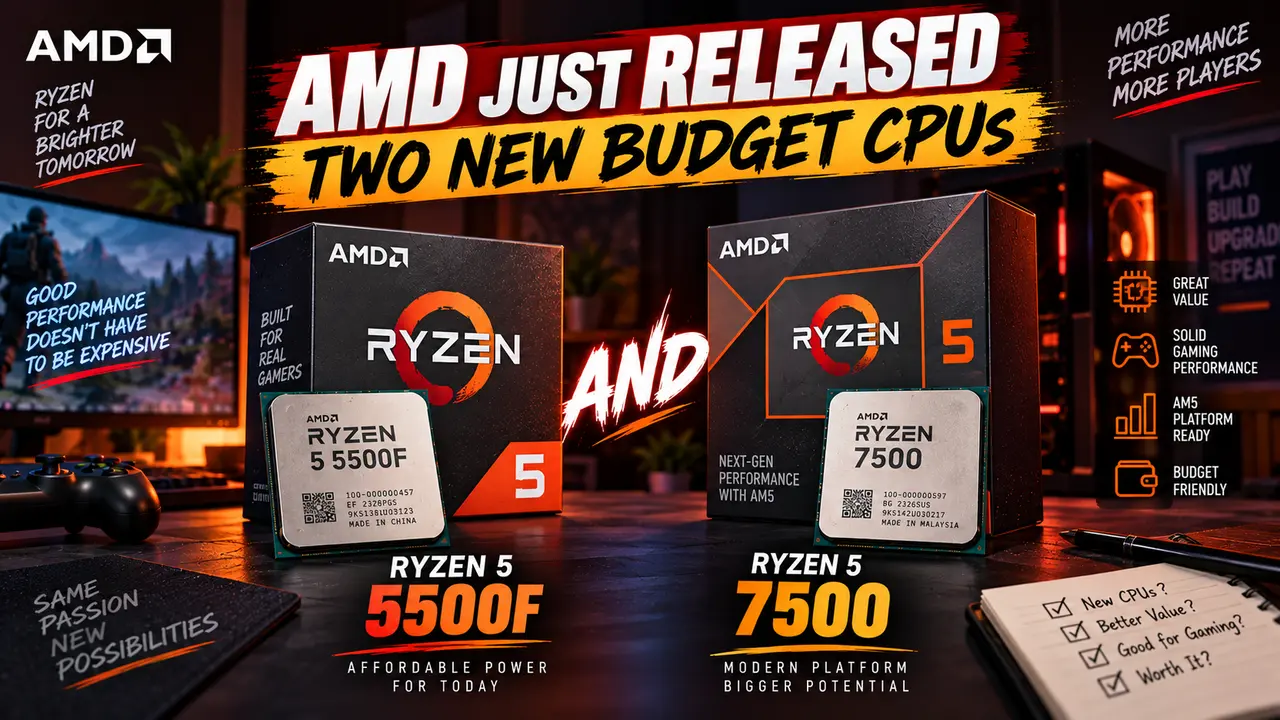
AMD doesn’t normally add new SKUs to a three-year-old chip architecture without a reason, and this one isn’t subtle. On September 10, the company officially launched two new budget processors — the Ryzen 5 5500F for AM4 and the Ryzen 5 7500 for AM5 — and the framing from AMD’s own marketing wasn’t about performance at all. It was about softening the blow from a component market that’s gotten genuinely painful for anyone trying to build a PC on a budget this year.
The Ryzen 5 5500F: an old socket gets one more reason to stick around
The AM4 platform has had an unusually long life, and AMD clearly isn’t done with it yet. The Ryzen 5 5500F is a six-core, twelve-thread chip running a 3.0GHz base clock and boosting up to 4.4GHz, inside a 65W thermal envelope — specs that, on paper, look close enough to the existing Ryzen 5 5500 that you’d assume it’s a simple rebrand. It isn’t.
Here’s the detail worth actually knowing before you buy one: the standard Ryzen 5 5500 is built on AMD’s monolithic Cezanne silicon, the same die family used in its integrated-graphics APUs, just with the graphics core disabled and capped at PCIe 3.0. The new 5500F is a different animal entirely — it’s built on the Vermeer chiplet architecture, the same underlying design as the pricier Ryzen 5 5600, essentially functioning as a cut-down 5600 rather than a cut-down 5500. That distinction shows up in one very practical spec: PCIe 4.0 support, which the standard 5500 doesn’t have. If you’re planning to pair a budget CPU with a current-generation SSD or graphics card, that’s not a minor footnote — PCIe 3.0’s bandwidth ceiling genuinely limits what some modern components can actually deliver.
The catch, and there’s always a catch with a cut-down chip, is cache. The 5500F carries less cache than the full Ryzen 5 5600 it’s derived from, which is exactly how AMD is able to price it well below its sibling without cannibalizing the higher-margin part. At $99 in the US (£87.98 through UK retailer Scan Computers), it’s priced about 34 percent above the existing Ryzen 5 5500 — a premium AMD is justifying with that slightly higher boost clock and, more significantly, the PCIe 4.0 support the older chip simply doesn’t offer.
The Ryzen 5 7500: mostly a rebrand, with one meaningful addition
The AM5 side of this launch is a simpler story. The Ryzen 5 7500 is, spec for spec, the same processor as the Ryzen 5 7500F that’s been on the market for three years — same Zen 4 cores, same 3.7GHz base and 5.0GHz boost clocks, same 65W TDP, same 38MB of total cache split across 6MB of L2 and 32MB of L3. The one change is right there in the name: AMD added back integrated Radeon graphics, a small RDNA 2-based unit running two compute units at up to 2.2GHz.
That’s a genuinely useful addition for a specific kind of buyer, even if it looks unremarkable on a spec sheet. First-time builders, budget office PCs, and anyone assembling a system before they’ve saved up for a discrete GPU all benefit from a chip that can output a display on its own, rather than requiring a graphics card just to see a BIOS screen. It’s priced at $189 in the US, or £167.99 through Scan Computers in the UK, with US retail availability starting immediately and UK stock following through pre-order, arriving September 29.
Why AMD did this now, and it’s not really about the CPUs themselves
Reporting around this launch has connected it directly to something PC builders have been feeling all year: memory prices have gotten genuinely ugly. DDR5 kits have climbed sharply through 2026 as AI infrastructure demand pulls DRAM manufacturing capacity away from consumer channels, with 32GB kits reportedly approaching $400 in some markets — a jump of several hundred percent from where pricing sat just a year earlier. GPU prices have climbed too, with both Nvidia and AMD pushing through list-price increases on current-generation cards.
Against that backdrop, the CPU is often the smallest line item on a budget build sheet, but that’s exactly the point of this release. A cheap, capable six-core chip doesn’t fix the RAM market, but it does free up a little more of a tight budget to put toward the parts that have actually gotten more expensive. For the Ryzen 5 7500 specifically, there’s a second angle: a working integrated GPU means a first-time builder can get a functioning PC running today and add a discrete graphics card later, once GPU pricing hopefully calms down, rather than being blocked from booting a system at all until they can afford both a CPU and a GPU in the same purchase.
The honest catch: is the Ryzen 5 7500 actually worth buying?
Here’s where I’d slow down before recommending this one universally. Coverage of the launch has flagged a real problem with the Ryzen 5 7500’s positioning: AMD’s own Ryzen 5 9600X, a genuinely newer Zen 5 chip, has been spotted at UK retailer Scan Computers for roughly the same money — £161.99 against the 7500’s £167.99. The 9600X runs on newer silicon with higher clock speeds, and at that kind of price parity, there’s not an obvious reason to pick the three-year-old architecture with a bolted-on iGPU over the actually current chip, unless integrated graphics is a specific, non-negotiable requirement for your build.
The Ryzen 5 5500F doesn’t have that same problem — it’s carving out space in the AM4 market that current-generation chips simply don’t compete in, since there’s no newer AM4 silicon to undercut it with. If you’ve got an existing AM4 motherboard, or you’re building specifically around the AM4 platform’s lower entry cost, the 5500F looks like a genuinely sensible budget pick. The Ryzen 5 7500 is a murkier recommendation, and it’s worth actually pricing out the 9600X before committing.
Where this leaves budget builders
If you’re upgrading an aging AM4 system or building fresh on that platform specifically to keep costs down, the Ryzen 5 5500F is a legitimate, well-targeted release — cheap, PCIe 4.0-capable, and filling a real gap in AMD’s aging but still-supported budget lineup. If you’re building fresh on AM5 and specifically need integrated graphics to get a system running before you can afford a discrete GPU, the Ryzen 5 7500 does what it says on the box, but shop around first — if a Zen 5 Ryzen 5 9600X is sitting at a similar price where you’re buying, that’s very likely the better chip for the same money, iGPU aside.
At The End
Neither of these releases is exciting on a spec sheet, and that’s sort of the point — this wasn’t AMD chasing a performance headline, it was AMD triaging a budget PC market that’s been squeezed hard by RAM and GPU pricing all year. The 5500F earns its place by genuinely improving on AM4’s budget tier. The 7500 earns a more cautious recommendation, useful specifically for buyers who need built-in graphics right now, less useful for anyone who can shop past it toward AMD’s own newer, similarly priced silicon.
This story is based on launch-day reporting from September 10, 2026. Regional pricing and stock availability are still settling in as retailers catch up, so it’s worth checking current listings before publishing final pricing figures.