PS5 vs PC
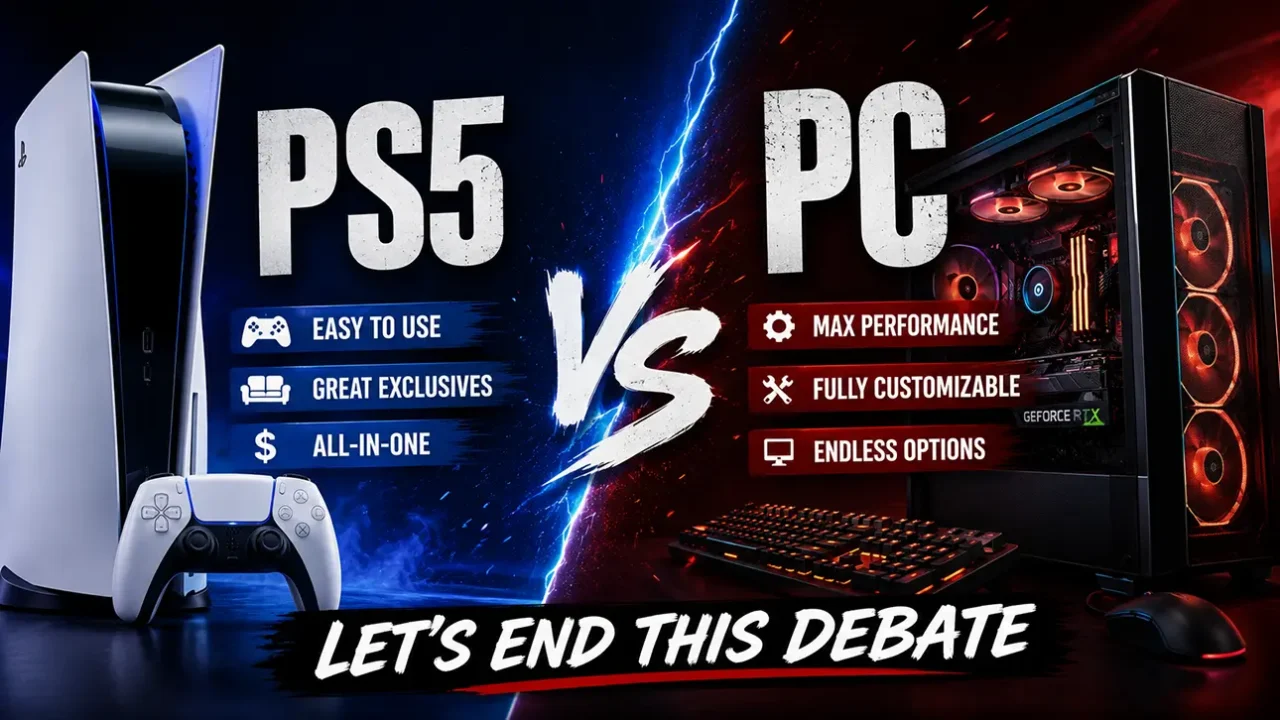
PS5 vs PC This is one of those debates that never really gets settled, and I don’t think that’s an accident. Both sides have gotten genuinely stronger arguments over the past couple of years, not weaker, which is the opposite of what usually happens as a console generation ages. So let’s actually dig into where things stand right now, because the honest answer depends more on what kind of gamer you are than most comparison articles let on.
The price gap has narrowed a lot more than people realize
Here’s something that would’ve sounded absurd a couple of years ago: console prices have actually climbed close enough to entry-level PC territory that the old “just buy a PS5, it’s cheaper” argument doesn’t land the way it used to. A round of DRAM-driven memory price hikes pushed the PS5 up to $649, putting it in the same neighborhood as budget PC builds that now start around $700 in raw components. That gap used to be a few hundred dollars in the console’s favor. Now it’s practically a rounding error.
Step up to the PS5 Pro and the math gets even more interesting. At $899.99, it’s no longer the budget-friendly option it once was. A PC build that actually matches its performance — something like a Ryzen 5 7600X3D paired with an RX 9060 XT 16GB or RTX 5060 Ti 16GB, 32GB of RAM, and a 2TB SSD — typically lands somewhere between $963 and $1,200 for the core components alone, before you factor in a Windows license, case, power supply, or peripherals. So yes, the PC still costs more once you add everything up. But it’s no longer the “console is half the price” gap that used to make this an easy call.
Where PC pulls decisively ahead: the performance ceiling
This is the one area where there’s genuinely no contest, and I don’t think it’s close. High-end PC hardware simply reaches places consoles structurally can’t follow. An RTX 5090 can sustain well over 200 frames per second in demanding titles at settings a console isn’t built to attempt, and even a more modest RTX 5070 comfortably handles 4K at 120fps in most current games. The PS5 Pro, for all its real improvements, tops out closer to 4K at 120Hz with dynamic resolution scaling doing a lot of the heavy lifting behind the scenes to hit that number consistently.
VRAM tells a similar story. High-end PC builds are running 32GB or more of GDDR7 memory now, comfortably handling 8K-resolution textures without breaking a sweat, while console memory pools remain capped well below that. None of this means the PS5 Pro looks bad — Sony’s PlayStation Spectral Super Resolution upscaling tech genuinely produces image quality that rivals native 4K in performance modes, and demanding exclusives are tuned specifically to run at their best on that hardware. It just means “the absolute performance ceiling” and “console gaming” aren’t really the same conversation anymore, if they ever fully were.
The subscription math nobody adds up until it’s too late
This is the part of console ownership that tends to get glossed over in the initial price comparison, and it shouldn’t be. PS Plus runs somewhere in the $80 to $160 per year range depending on the tier, and that’s not optional if you want to play most multiplayer games online. Stretch that across a typical three-year ownership window and you’re looking at close to $400 just for the privilege of playing online — money that doesn’t buy a single game, just the ability to connect to one.
PC gaming isn’t subscription-free by any means if you want cloud saves or certain premium services, but the core experience of playing online with friends doesn’t carry that same mandatory yearly toll. Combine that with how aggressively PC storefronts discount games — seasonal Steam sales and recurring Epic Games Store freebies both push the average cost per game down meaningfully over time — and the total-cost-of-ownership picture shifts more toward PC the longer you actually own the thing.
Upgradability: the difference between owning a platform and owning a snapshot
A PS5 or PS5 Pro is what it is on the day you buy it, and what it’ll still be five years from now. There’s no swapping in a faster GPU when the next generation of games starts demanding more. A PC, by contrast, lets you replace individual components as your needs or budget shift — a new graphics card here, more RAM there — which means a well-maintained PC build can realistically stay competitive far longer than a fixed console generation’s typical six-year cycle.
That flexibility cuts both ways, worth being honest about. It also means a PC build can fall behind if you never actually upgrade it, and the console’s fixed hardware target is exactly why developers can optimize so tightly for it — a game built for one specific configuration tends to run more consistently than the same game trying to accommodate thousands of different PC hardware combinations. Consoles largely sidestep the stuttering, driver quirks, and settings-tweaking rabbit holes that PC gaming can occasionally throw at you. That’s a real trade-off, not a one-sided win for either side.
Exclusives: still the strongest card Sony has to play
No amount of raw horsepower changes the fact that Sony’s first-party lineup simply isn’t available on PC at launch, and in some cases not at all. The God of War series, Marvel’s Wolverine, Gran Turismo, Spider-Man — these are console-defining titles built and tuned specifically around PlayStation hardware, and if any of them are must-plays for you, that consideration alone can settle the whole debate regardless of what the spec sheets say. Sony has gotten more willing to bring older exclusives to PC after a delay in recent years, but “eventually, a year or two later, maybe” isn’t the same as “at launch,” and plenty of players simply don’t want to wait.
Where PC pulls ahead beyond raw power: competitive gaming
If competitive multiplayer is a meaningful part of what you play, this one isn’t particularly close either. Titles like Warzone, Valorant, Fortnite, and Counter-Strike 2 benefit enormously from uncapped frame rates that only PC hardware can consistently deliver, and mouse-and-keyboard input still offers a precision edge over a controller in most competitive genres. If your gaming time skews heavily toward ranked shooters or esports-adjacent titles, that advantage compounds every single match.
So which one should you actually buy?
Skip the abstract “which is objectively better” framing, because that’s not really the right question. Ask yourself what you’re actually going to do with it. If your library is built around Sony’s exclusives, you want something that works the moment you plug it in with zero troubleshooting, and your gaming happens on a couch in front of a TV, the PS5 or PS5 Pro remains the more sensible, lower-friction choice — and at this point it’s not even meaningfully cheaper than a comparable PC, it’s just easier.
If you’re drawn to competitive multiplayer, want the ceiling to keep rising as you upgrade individual parts over the years, care about mod support and a back catalog running into the tens of thousands of titles, or mostly game at a desk anyway, a PC build makes more long-term sense despite the higher upfront cost and the occasional technical hiccup that comes with more open hardware.
And if you genuinely can’t choose, that’s a completely reasonable place to land too. A meaningful number of serious gamers end up running both — a console for the couch and the exclusives, a PC for everything else — treating them as complementary rather than competing purchases. It’s not the cheapest path, but if your budget allows it, it’s arguably the one that actually eliminates the trade-offs from either side individually.