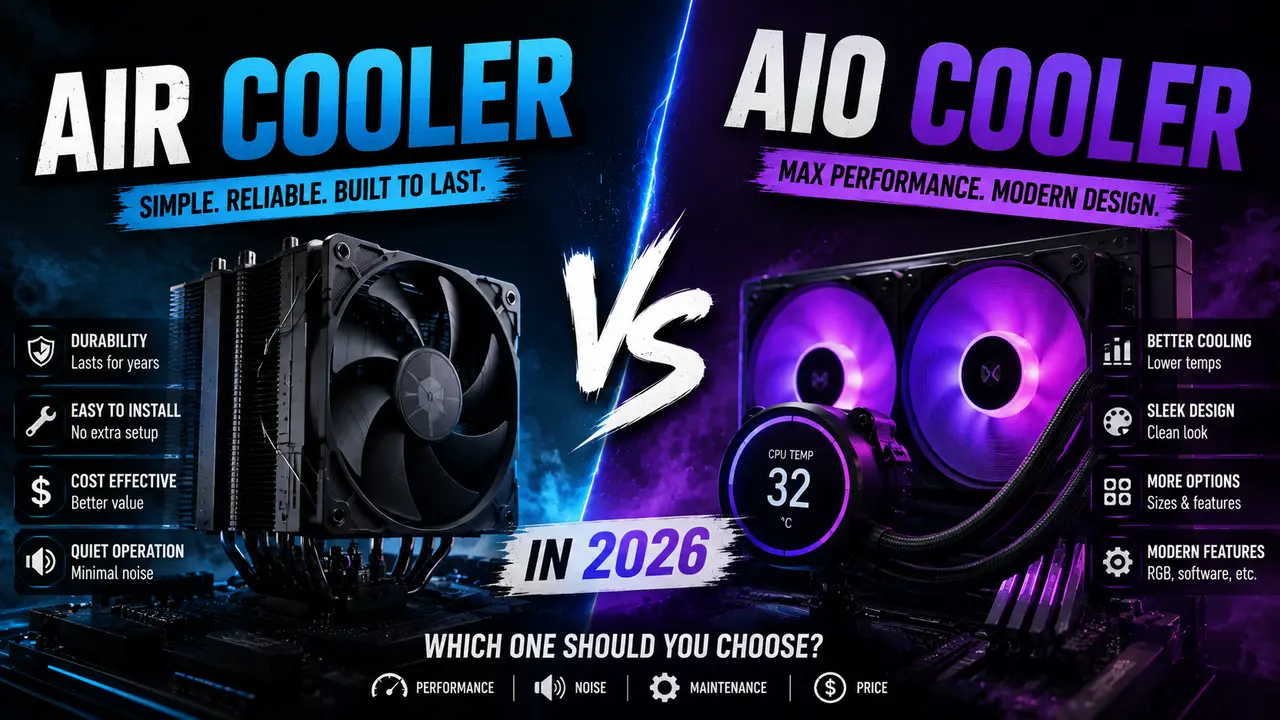
Air Cooler vs AIO in 2026
Every build thread eventually hits this question, and it tends to get answered with more confidence than the evidence actually supports. Someone insists air coolers are a relic. Someone else insists AIOs are just expensive plumbing waiting to fail. Both of those takes are wrong often enough that I want to actually walk through the real trade-offs instead of picking a side and defending it.
The wattage line has shifted, and it’s worth knowing where it sits now
There’s a genuinely useful rule of thumb that’s held up through 2026: air coolers handle sustained loads up to around 260W reliably, while AIOs start earning their keep once you’re consistently pushing past 300W. — think Intel’s Core i9-14900KS or AMD’s Ryzen 9 7950X3D derivatives — regularly sustain draws above 260W under real sustained workloads, not just synthetic benchmark spikes. A few years ago that line sat comfortably higher, and most mainstream CPUs never got close to it. Now, if you’re running one of the genuinely power-hungry flagship chips, you’re closer to that line than you might assume.
The honest caveat here: check whether a cooler’s advertised TDP rating is measured under sustained heavy load or a synthetic burst test, because manufacturers aren’t always consistent about which one they’re quoting. A cooler rated for “280W” in marketing copy sometimes means 280W briefly, not 280W for twenty minutes of gaming.
Reliability: this is where air coolers have a genuinely strong case
An air cooler is, mechanically, about as simple as a component gets — a metal heatsink, some heat pipes, and one or two fans. The only moving parts are the fans themselves, and if one dies five years down the line, you’re looking at a $20 replacement and a few minutes of your time. That’s the whole failure scenario, start to finish.
AIOs carry more going on internally: a pump, a sealed loop of circulating liquid, tubing, a radiator. Most of the time, none of that causes a problem — modern AIO pumps are genuinely reliable, and outright failures aren’t the norm. But it’s still a real category of failure that air cooling simply doesn’t have, and when a pump does die, you’re not looking at a cheap fan swap. You’re usually looking at replacing the entire unit. If long-term, set-it-and-forget-it peace of mind matters more to you than squeezing out the last few degrees of thermal headroom, that asymmetry is worth taking seriously.
Where AIOs actually pull ahead on pure performance
I don’t want to undersell this side, because it’s real: 360mm and 420mm AIOs do dominate flagship CPUs under sustained, high-wattage load, and they’ve gotten meaningfully better at handling something specific — the sudden transient temperature spikes that modern CPUs throw off constantly thanks to aggressive boost algorithms. Liquid has a higher specific heat capacity than the metal in an air cooler’s heatsink, meaning it can absorb those sudden thermal spikes more gracefully before temperatures climb. On a chip that’s aggressively boosting clock speeds moment to moment, that difference shows up as slightly higher sustained boost clocks over a long session, not just a cooler-looking number on a monitoring overlay.
That said, the gap is smaller than the marketing around it suggests once you’re not at the absolute top of the CPU stack. A quality dual-tower air cooler delivers somewhere around 90 percent of a premium AIO’s performance for roughly half the price, and for most mid-range builds, that remaining 10 percent translates to a couple of degrees Celsius under load — not the difference between stable and thermal-throttled.
Money spent past a certain point stops buying you much
Here’s a pattern worth internalizing before you start browsing: value on both sides flattens out hard past a certain price. On air cooling, spending beyond roughly $100 runs into sharply diminishing returns — a $135 premium air cooler like the Noctua NH-D15 isn’t dramatically outperforming a well-built $75 mid-tier unit by much once you’re cooling a mainstream CPU rather than a flagship. AIOs hit a similar wall around $160; past that, you’re mostly paying for aesthetics, larger radiators for niche case configurations, or prep work toward a full custom loop rather than meaningfully better everyday cooling.
Roughly, current pricing breaks down like this: budget air coolers in the $30 to $50 range handle CPUs up to about 65W comfortably. Mid-tier air, around $55 to $95, comfortably covers 105 to 125W chips. Premium air, $100 to $135, is the sweet spot for 125 to 160W processors. On the liquid side, 240mm AIOs run $85 to $140 and deliver consistently better delta-T than air at the same price point, while 360mm units in the $150 to $220 range are where you land if you’re cooling something genuinely power-hungry.
Aesthetics and case fitment, because it’s a legitimate factor
I won’t pretend this doesn’t matter to a lot of people, because it clearly does. AIOs give you a cleaner internal layout and leave your RAM slots fully unobstructed — no worrying about a tower cooler’s fan shroud clipping tall memory heatsinks. If you’re building in a case with a tempered glass panel and you actually care how the inside looks, that’s a real point in the AIO column that has nothing to do with thermal performance and everything to do with what you’ll be staring at every time you glance at your desk.
On the flip side, if you’re going the air-cooler route with a tall tower cooler, check your RAM clearance before you buy — you generally want at least 42mm of clearance for taller DDR5-6000-class kits, and it’s worth double-checking for VRM heatsink interference too, since some B650, X670, and budget H610 boards run tall enough in that area to cause a fitment surprise you don’t want to discover after the parts have already arrived.
So which one should you actually buy?
If you’re building a mainstream gaming PC with a CPU that isn’t pushing 260W-plus under sustained load, a quality air cooler is the right call, full stop. It’s cheaper, quieter at idle for most models, has fewer things that can go wrong over a five-year lifespan, and gets you within a couple degrees of what a same-priced AIO would deliver anyway. The Noctua NH-D15 G2 and Arctic Freezer 36 both keep coming up across current testing for good reason — they’re not exciting purchases, and that’s kind of the point.
Reach for an AIO if you’re running a genuinely flagship-tier, power-hungry CPU under sustained heavy load, you’re building in a compact case where a tower cooler’s clearance requirements become a real problem, or the clean aesthetic and unobstructed RAM slots are worth a premium to you. The Arctic Liquid Freezer III Pro keeps showing up as a strong pick in that category, striking a decent balance between performance and cost without demanding the largest possible case just to fit it.
The bottom line
Neither side of this debate is wrong, which is honestly why it never fully resolves. Air cooling wins on reliability, value, and simplicity for the CPUs most people are actually running. AIOs win on peak sustained performance for genuinely hot chips and on looking good behind a glass panel. Match the choice to your actual CPU’s power draw and your actual priorities, not to whichever side was louder in the forum thread you read last.