Prebuilt Pc vs Custom Built
For basically twenty years, this wasn’t a real debate. Building your own PC saved money, full stop, and the only people buying prebuilts were folks who genuinely didn’t want to deal with the process. That rule held through recessions, through crypto booms, through every GPU shortage that came before this one. It just quietly broke sometime in 2026, and I don’t think enough people have actually noticed yet.
Why the math flipped, and it’s not because prebuilts got better
The short version: it’s not that manufacturers suddenly started offering better deals out of generosity. It’s that the component market underneath both paths got genuinely ugly, and the two paths absorbed that damage very differently. RAM prices reportedly climbed something like 89 percent in a single quarter this year, and that’s on top of prices that had already roughly tripled since late 2025 thanks to AI data centers hoovering up DRAM and SSD manufacturing capacity. A 32GB DDR5 kit that ran $100 to $130 in early 2025 is now commonly running $300 or more.
Here’s the part that actually matters for this comparison, though. Large manufacturers building prebuilts buy components by the container, months in advance, on negotiated bulk contracts. A lot of them had already locked in inventory and pricing before this spike hit. Individual DIY builders buy at spot market prices, today, whatever the market happens to be charging this week. When the underlying parts market gets this volatile, that gap between contract pricing and spot pricing becomes the entire story. It’s the same reason a big-box retailer can sometimes sell you a finished sandwich cheaper than you could buy the individual ingredients — bulk purchasing power just works differently than one person buying one of everything.
What that actually looks like in dollars
A gaming build that used to come in comfortably under $1,000 is now more commonly landing around $1,200 to $1,250, and that’s before you’ve added an operating system license. Meanwhile, prebuilt retailers — Costco has come up repeatedly in recent comparisons — are moving complete systems with 32GB of DDR5, a genuinely usable GPU, and the rest of a solid spec sheet for right around that same $1,000 mark. That’s not a small nudge in the numbers. That’s the prebuilt beating the parts-only DIY total before you’ve even accounted for your own labor putting it together.
I want to be careful here, because “prebuilts are cheaper now” isn’t universally true across every price point, and treating it that way would be misleading. It’s true in a specific, fairly wide band. Below that band and above it, the old logic still mostly holds.
Where DIY still wins
At the very budget end — realistically, under about $900 — building it yourself still tends to come out ahead, because that’s where the margin manufacturers need to bake into a finished, warrantied, boxed product actually shows up as a real percentage of the total price. If you’re stretching every dollar and willing to hunt for deals part by part, DIY remains the tighter path down there.
At the high end, things flip back too. Above roughly $2,500, the contract-pricing advantage that’s carrying prebuilts through the middle of the market starts fading in relative terms, and hand-picking every component to squeeze out the best performance per dollar becomes the stronger move again. If you’re speccing something genuinely high-end, building it yourself is still very likely to net you more machine for the money.
Where prebuilt has quietly taken over
The band in between — roughly $1,000 to $1,900, sometimes pushed as high as $2,500 depending on which comparison you’re reading — is where this whole conversation has actually shifted. That’s a huge chunk of the market. It’s basically the entire range most people shopping for a solid gaming PC are actually looking at, and it’s exactly where prebuilt contract pricing is currently landing you a GPU tier or RAM capacity you genuinely could not assemble yourself for the same money this week.
The trade-offs that aren’t about price at all
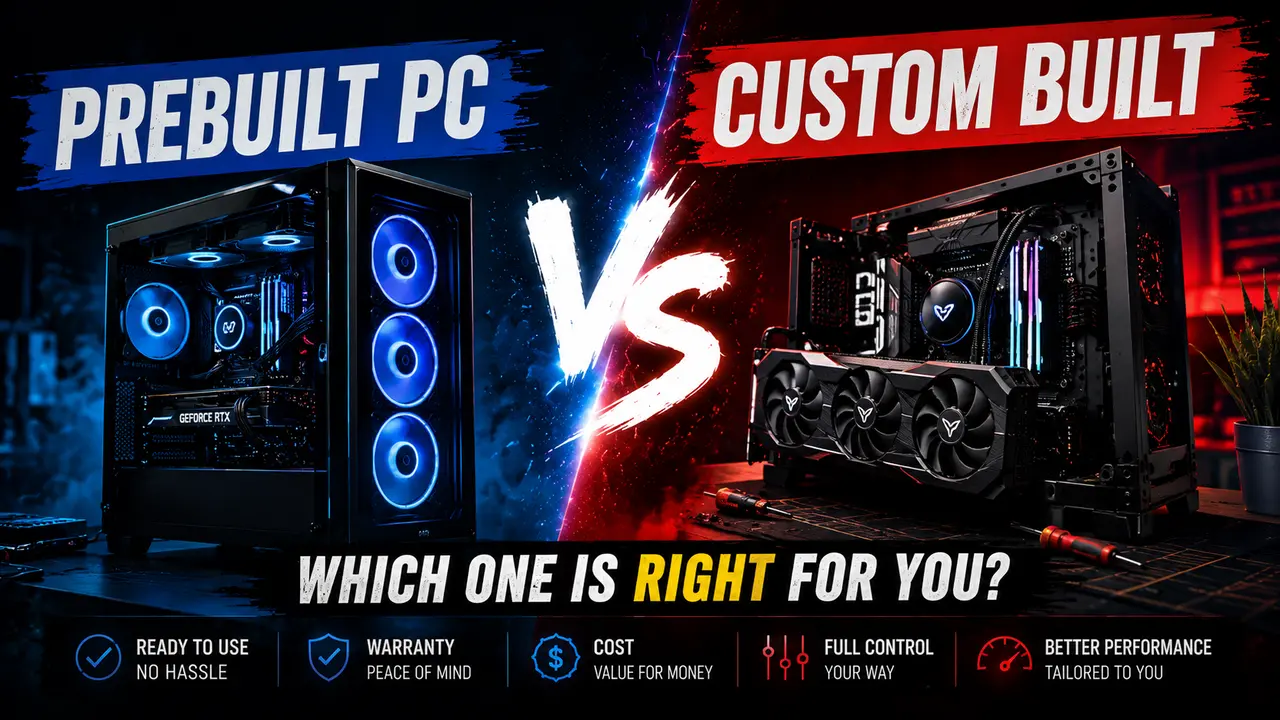
Money aside, there’s a real argument for prebuilt that has nothing to do with the current shortage, and it’s worth taking seriously even once prices eventually normalize. Your time has value. If a DIY build saves you a couple hundred dollars but costs you an entire weekend, plus the mental overhead of researching every component for compatibility, that trade isn’t automatically a win just because the sticker price was lower.
Support is the other underrated factor. Something goes wrong on a DIY build, and you’re the one figuring out whether it’s the RAM, the motherboard, or the GPU, then filing separate warranty claims with three or four different manufacturers, each with their own process and turnaround time. A prebuilt with proper manufacturer support means one phone call handles the whole system, because one company sold you the whole system and is on the hook for all of it. That’s a meaningfully different experience when something actually breaks, not just a nice-to-have you’re paying extra for and never using.
Where DIY keeps its edge regardless of pricing: genuine customization, and a real upgrade path. If you already own a case, PSU, or storage worth reusing from a previous build, that changes your math immediately in DIY’s favor, since you’re not paying to duplicate hardware you’ve already got sitting on a shelf. And if you know you’ll want to swap out one part at a time over the next few years rather than replacing the whole machine, building gives you a system actually designed for that from day one, where a lot of prebuilts use proprietary or space-constrained parts that make later upgrades harder than they should be.
The trap to watch for in a “great deal” prebuilt
Not every attractively priced prebuilt deserves the price tag, and this is worth flagging specifically because it’s an easy mistake to make when you’re relieved to find something under budget. A recent comparison flagged a prebuilt that undercut an equivalent custom build by over $150 — genuinely good on paper — except the GPU inside was an 8GB variant, which simply isn’t enough VRAM for demanding modern titles regardless of how good the rest of the spec sheet looks. Read the actual GPU model and VRAM capacity on any prebuilt you’re considering, not just the headline price and the brand name on the card. A killer deal on a system that’s going to stutter in two years’ worth of games isn’t actually a deal.
A quick way to decide
If your budget’s under $900, lean DIY and hunt for deals on individual parts — you’ll likely still come out ahead. If you’re in that $1,000-to-$1,900 range, seriously compare a few well-reviewed prebuilts against your own parts list before assuming building is automatically cheaper right now, because in this specific market, it probably isn’t. If you’re spending north of $2,500, building it yourself still tends to get you meaningfully more machine for the money. And regardless of budget, if your time is genuinely scarce or you want the safety net of one company handling support if something breaks, that’s a legitimate reason to pay a little extra for a prebuilt even outside the range where it’s the outright cheaper option.
The bottom line
This isn’t a permanent shift in how PC hardware works — it’s a temporary distortion caused by a memory and component shortage that will eventually ease. But “eventually” isn’t a purchase date, and if you’re buying right now, the twenty-year-old assumption that building always saves money simply isn’t reliable in today’s market. Run the actual numbers for your specific budget before you commit to either path. The right answer has genuinely changed depending on where you land on the price spectrum, and assuming otherwise is the one way you’re likely to overpay in this particular market.