Laptop vs. Desktop PC
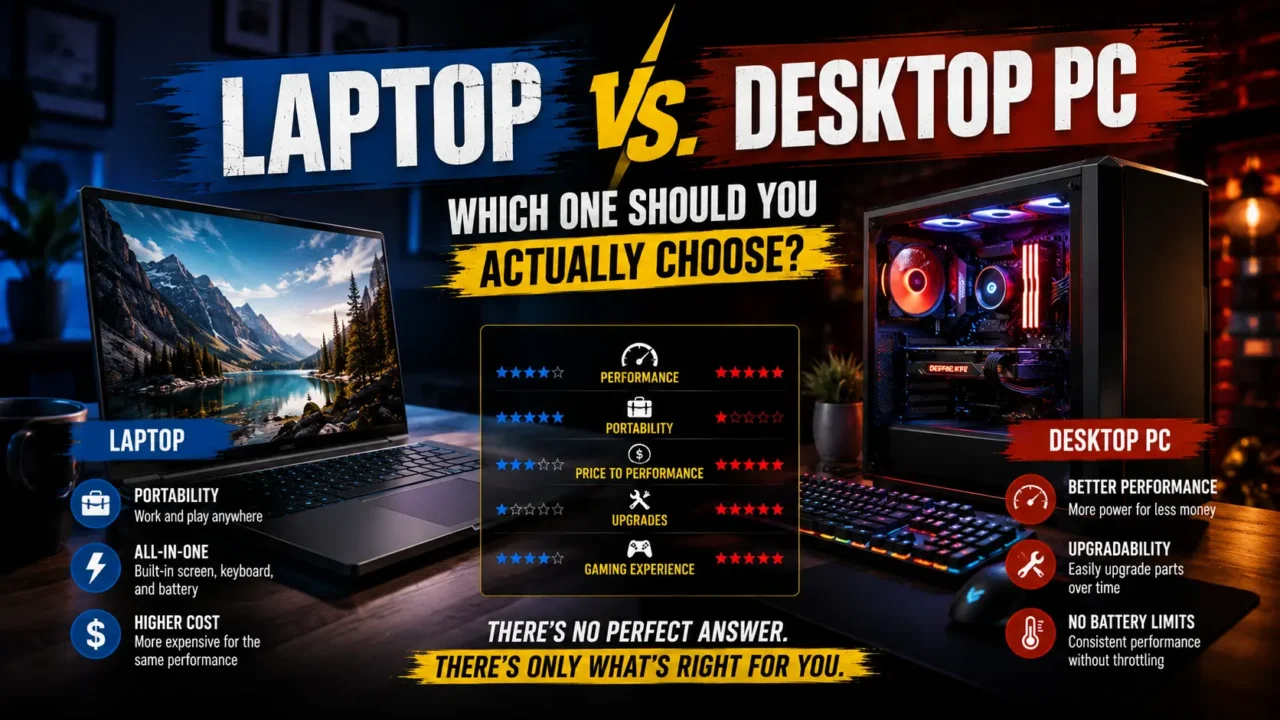
This question comes up constantly, and I think it survives so long precisely because both sides of the argument are genuinely true at the same time. Desktops really do deliver more performance for the money. Laptops really do offer something desktops fundamentally can’t. The debate isn’t which one is objectively better, because that’s not actually a coherent question — it’s which trade-off matches how you actually live and play.
Let’s get into where the real gaps are, because some of them are bigger than people expect, and a few have narrowed more than the old conventional wisdom gives credit for.
The performance gap is real, and it starts with power, not architecture
Here’s the single biggest technical reason desktops pull ahead: a desktop GPU runs at its full power limit inside a case built to feed it constant airflow, while a laptop GPU carrying the exact same model name is deliberately capped to survive inside a chassis a few centimeters thick. That’s not a manufacturing shortcut — it’s physics — you can’t cram desktop-tier cooling into a laptop lid no matter how clever the vapor chamber design gets.
The numbers back this up pretty consistently across independent testing. Multiple 2026 comparisons put desktops somewhere around 20 to 40 percent ahead in frames-per-dollar against a similarly priced laptop, with the gap widening the further up the price ladder you go. One detailed comparison I came across ran the numbers at 4K specifically and found a desktop using roughly 170 percent more power at the wall while still delivering 62 percent more frames — which, if you actually sit with that math, means the desktop is still coming out ahead on frames delivered per watt spent, just at a much higher absolute power draw.
Thermals compound the gap over a real gaming session, not just in a five-minute benchmark. Even well-cooled laptops — and there are genuinely good ones on the market — run their fans hard under sustained load and start throttling as chassis temperature climbs over a longer session. A desktop with proper case airflow just doesn’t fight that battle the same way. If your typical session is a three-hour evening rather than a twenty-minute round, that difference stops being a spec-sheet footnote and starts being something you actually feel.
Price: the premium is smaller than the specs suggest, but it’s still a premium
According to XoticPC’s 2026 pricing analysis, a laptop built around an RTX 5060 Mobile GPU runs roughly 20 to 30 percent more expensive than a desktop at the equivalent GPU tier — and that gap gets wider, not narrower, as you climb toward flagship-tier hardware. On the low end, expect a competent desktop build to start somewhere around $700 to $900, against comparable laptop systems that tend to start closer to $900 to $1,000 for similar real-world performance.
There’s a wrinkle worth mentioning here, though, because it’s easy to miss if you’re just comparing GPU-tier-to-GPU-tier. A premium gaming laptop with a genuinely good 4K OLED, high-refresh display is effectively bundling in a monitor that would cost $900 or more on its own if you bought it separately for a desktop build. That doesn’t erase the price gap, but it does mean the comparison isn’t quite as lopsided as a bare hardware-spec chart makes it look, especially if you were going to buy a nice monitor anyway.
Upgradability: this is where the gap becomes permanent, not just temporary
A desktop’s GPU, CPU, RAM, and storage can all be swapped independently as your needs change or your budget allows, which means a well-built desktop can realistically stretch across five to seven years of relevance through incremental upgrades rather than a full replacement. Laptops mostly don’t offer that path. Most current models allow RAM and storage upgrades if you’re willing to open the case, but the GPU and CPU are soldered in for the life of the machine. That caps a typical gaming laptop’s realistic competitive lifespan closer to three or four years before you’re looking at a full replacement rather than an upgrade.
That’s not a knock on laptops so much as an honest description of the trade-off. You’re not buying a platform you’ll incrementally improve. You’re buying a complete package that will age as a single unit.
Where laptops actually win, and it’s not a small thing
None of the above changes the one advantage desktops genuinely cannot offer: you can close a laptop lid and take your entire gaming setup to a friend’s place, a dorm room, a coffee shop, or across the country, and have it fully functional twenty minutes later. That’s not a minor convenience footnote you can shrug off in a spec comparison. For students, frequent travelers, or anyone who splits time between multiple locations, that flexibility isn’t a nice-to-have — it’s often the actual deciding factor, full stop, regardless of what a frames-per-dollar chart says.
Mobile GPU technology has also genuinely closed some of the old gap. Nvidia’s RTX 50-series mobile chips lean on DLSS 4 and improved Max-Q power efficiency tech to squeeze meaningfully more real-world performance out of the same thermal envelope than mobile GPUs managed even a couple of generations back. A modern gaming laptop running current upscaling tech can hit high or ultra settings in most AAA titles without embarrassing itself, even if it’s not matching a desktop running the same GPU name badge at full, uncapped power.
A practical way to actually decide
Skip the spec-sheet comparison for a second and ask yourself a more honest question: how often do you actually need to move your setup somewhere else? If the honest answer is “basically never, I game at the same desk every time,” a desktop is going to outperform and outlast a similarly priced laptop for years, and you’d be paying a real premium for portability you’re not using. If the honest answer is “regularly, and it actually matters to my life,” the laptop’s premium stops being a waste and starts being exactly what you’re paying for.
There’s also a middle path worth mentioning that doesn’t get talked about enough: some buyers split the difference entirely, running a solid mid-range desktop at home for actual gaming performance, alongside a thinner, cheaper productivity laptop purely for travel and schoolwork or office tasks. Priced out together, that combination sometimes lands at roughly the same total cost as one premium gaming laptop trying to do both jobs at once — while doing each individual job noticeably better.
At The End
If you’re optimizing purely for performance per dollar and you’re realistic about how rarely you’ll actually move the machine, a desktop is the clearer answer almost every time, and it isn’t particularly close. If portability is a genuine, recurring need rather than a hypothetical one, that premium buys you something real that no desktop, no matter how well built, can offer. The mistake isn’t picking either option. It’s picking the wrong one because you talked yourself into needing flexibility you’ll actually use twice a year.