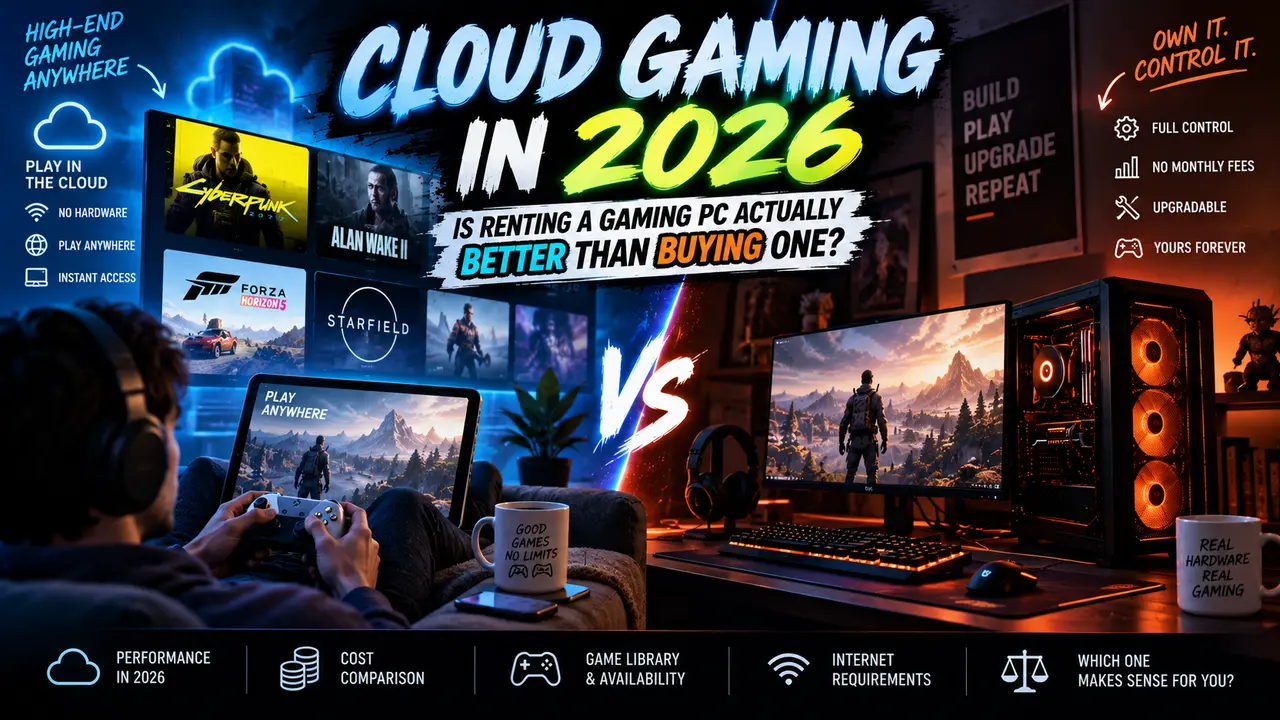
There’s a specific kind of moment that’s been playing out across a lot of living rooms this year: someone opens a tab to price out a new graphics card, sees what GPUs are actually going for right now, closes the tab, and opens a cloud gaming sign-up page instead. That’s not a hypothetical. With DRAM and GPU prices having climbed steadily for over a year, even entry-level hardware now costs meaningfully more than it did a couple of years back, and that single fact is a big part of why cloud gaming stopped being a novelty and became something people are seriously weighing as an alternative to buying silicon at all.
I want to be upfront about something before diving in, though: cloud gaming solving your hardware budget problem doesn’t automatically mean it solves your gaming experience problem. Those are two different questions, and this piece is mostly about the second one.
What you’re actually renting, and why that matters
The core idea is simple enough — instead of a GPU sitting in your case, your game runs on a GPU sitting in a data center somewhere, and the video gets streamed to whatever screen you’re holding. What varies enormously between services is what that arrangement actually gets you. Some services, like NVIDIA’s GeForce Now, are pure GPU rental — you point it at games you already own on Steam, Epic, Ubisoft Connect, or GOG, and it streams the exact build a local RTX rig would run, mods and custom settings included. Others, like Xbox Cloud Gaming, work more like a streaming library — you’re not renting hardware to run your own collection, you’re getting access to a rotating catalog of hundreds of included titles, day-one first-party releases among them, without needing to own anything at all.
That distinction matters more than most comparisons give it credit for. These aren’t really competing products solving the same problem. One is for someone who already has a PC game library and wants a portable way to run it without owning expensive hardware. The other is for someone who’d rather browse a Netflix-style catalog and never think about ownership in the first place.
Latency is the actual deciding factor, not resolution
Every service loves to advertise its maximum resolution and frame rate, and those numbers matter less than the industry’s marketing suggests. The real question is how much delay exists between you pressing a button and the game reacting, because cloud streaming adds a round trip to a data center on top of whatever lag your display and controller already introduce. For genre after genre, that added delay is either invisible or completely disqualifying, and it depends entirely on what you’re playing.
For single-player, story-driven, or turn-based games, current testing suggests the gap between local hardware and a well-optimized cloud stream has narrowed to the point where most people genuinely won’t notice it on a decent connection. For competitive multiplayer — Valorant, Fortnite, ranked shooters generally — that’s a different conversation entirely. A 20-millisecond difference is something a serious competitive player will actually feel, and even the best cloud services can’t fully erase that gap the way local hardware does.
GeForce Now currently posts the most competitive latency figures in independent testing, with some benchmarks showing 25 to 45 milliseconds on a strong connection, which starts approaching what local hardware feels like. Xbox Cloud Gaming and the budget-tier services generally run somewhat higher, though for anything that isn’t twitch-reflex competitive, most players find those numbers entirely acceptable. Every service, without exception, degrades hard below roughly 25 Mbps of connection speed, so your internet plan matters here just as much as which service you pick.
The current lineup, service by service
GeForce Now remains the performance leader, and it’s structured in tiers that scale with what you’re willing to pay. A free tier exists purely to test whether your connection can handle streaming at all, capped at 1080p with ads and short session limits. A mid tier, running somewhere around $10 a month, moves you to higher-end server hardware at up to 1440p. The top Ultimate tier, priced around $20 a month, streams from the newest server-class GPUs at up to 4K and high frame rates with genuinely low latency — though it’s worth knowing NVIDIA enforces a monthly hour cap on that top tier, so it’s not built for someone trying to replace unlimited daily gaming entirely.
Xbox Cloud Gaming takes the opposite approach, folded into a Game Pass Ultimate subscription that’s dropped in price over the past year. Rather than renting raw horsepower, you’re getting access to several hundred included games with no ownership required and no hard hourly limit, though it generally tops out at a lower resolution and frame rate ceiling than GeForce Now’s best tier. If you’d rather browse a library than manage one, this is the more natural fit.
PlayStation Plus Premium extends that same “included library” philosophy to Sony’s ecosystem, offering cloud streaming up to 4K for subscribers, following a price adjustment earlier this year. It makes the most sense specifically if you’re already invested in PlayStation exclusives and want to stream them across devices you wouldn’t otherwise have a console attached to.
Boosteroid has carved out real space as the budget pick, undercutting the bigger names significantly on an annual plan while still supporting 4K streaming without the hour caps some premium tiers impose. The trade-off is service reach — it works best when a server happens to be reasonably close to you, and results vary more by region than the bigger, more heavily invested competitors.
Amazon Luna, worth mentioning mainly as a warning, has largely fallen out of serious contention. Its standalone game store has been discontinued, and it’s really only worth touching now as a free perk bundled into an existing Prime subscription rather than something to sign up for on its own merits.
Who this actually makes sense for
If you’re a casual-to-moderate gamer who mostly plays single-player or slower-paced titles, doesn’t want to sink money into a graphics card during a period when GPU prices are genuinely inflated, and has a solid, stable internet connection, cloud gaming in 2026 is a legitimately good option — not just a compromise you settle for until you can afford real hardware. The gap has closed enough that this isn’t the janky, buffering experience early cloud gaming attempts left people remembering.
If you’re serious about competitive multiplayer, live in an area with unreliable or slow internet, or you’re the type who plays 100-plus hours a month and would burn through subscription hour caps constantly, the calculus shifts back toward owning hardware, or at minimum picking the specific service — likely an uncapped budget option — built around not penalizing heavy use.
AT THE END
Cloud gaming didn’t get good by accident, and it didn’t happen in a vacuum either — GPU pricing pain pushed adoption forward faster than the technology alone probably would have managed on its own. The honest verdict for 2026 isn’t “cloud gaming has replaced owning hardware.” It’s narrower and more useful than that: for a specific, genuinely large slice of gamers — casual players, story-driven game fans, people without $1,500 to sink into a graphics card right now — renting a data center GPU for ten to twenty dollars a month has become a real alternative worth taking seriously, not just a fallback for people priced out of the hobby entirely.