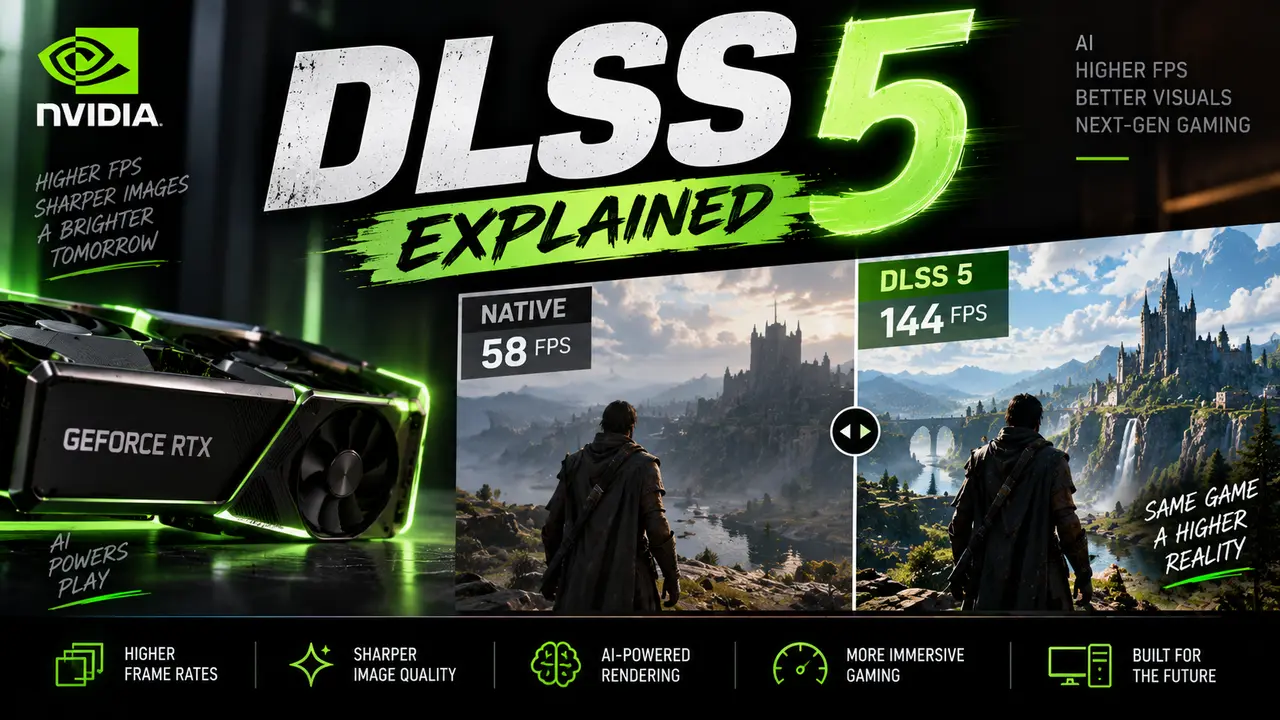
DLSS 5 Explained
Nvidia doesn’t usually get accused of ruining a game’s art style with a driver update. That’s exactly what happened this year with DLSS 5, and the story of how we got from “this looks like AI slop” in March to an actual public launch on September 3 is genuinely one of the stranger arcs in recent GPU history. Here’s what DLSS 5 actually is, why it caused such a fight, and what it’s like now that it’s finally in your hands.
This isn’t upscaling or frame generation – it’s something new entirely
Every previous version of DLSS, all the way through DLSS 4.5, worked by reconstructing information that technically already existed in the scene — upscaling a lower-resolution render, generating in-between frames, or cleaning up noisy ray-traced pixels using data the game engine already had. DLSS 5 does something categorically different. Nvidia calls it 3D-Guided Neural Rendering, and instead of reconstructing existing data, it uses AI to generate lighting and material detail that developers never actually rendered in the first place — the rich, expensive visual detail real-time performance budgets have always forced studios to strip out.
The model takes the game’s rendered frame along with the underlying engine data — color, motion vectors, lighting information, surface properties — as its foundation, then adds photoreal lighting, subsurface scattering, ambient occlusion, and contact shadows on top of what was actually rendered. Nvidia has pitched this as its biggest graphics breakthrough since real-time ray tracing debuted in 2018, which is a bold claim, and also exactly the kind of claim that invites the reaction it got.
Developers actually have real control over this, which matters for the controversy
Before getting into the backlash, it’s worth understanding that DLSS 5 isn’t a blind filter slapped over a finished game – there’s genuine developer tooling behind it. Studios can choose between different model weights through Model Selection, adjust Structure Intensity to control how much high-frequency detail like ambient occlusion and contact shadows gets added, and separately tune Tone Intensity for lighting and color response. An Automatic Masking system detects and isolates specific objects – characters, most notably — so the effect can be applied dynamically without a developer manually tagging every asset by hand. And critically, the whole thing is optional and can be switched off entirely, in-game, at any time.
That level of control matters, because it directly contradicts the “Nvidia is auto-generating your game” framing that dominated the initial reaction.
Why the internet decided this was “AI slop”
When Nvidia first demoed DLSS 5 at GTC 2026 back in March, the reaction was fast and brutal. Early tech demos showed visibly altered character models — Resident Evil Requiem’s Leon S. Kennedy and Grace Ashcroft became the most-cited examples, alongside Starfield — and critics immediately branded it generative “AI slop,” accusing Nvidia of steamrolling deliberate art direction with an algorithmic beauty filter. The characters in those early demos looked distinctly more idealized than their original designs, and a lot of people online reached for the same comparison: Instagram face filters, applied to AAA game characters.
The backlash reached Jensen Huang directly. At a GTC press Q&A, he pushed back firmly, arguing the criticism misunderstood how the technology actually works — that DLSS 5 combines developer control over geometry and textures with generative AI, rather than simply overriding an artist’s original work. In a later podcast appearance, he was more conciliatory, acknowledging he isn’t a fan of low-effort “AI slop” either, while maintaining that DLSS 5 preserves a game’s original structure and artistic intent rather than replacing it. Whether that framing landed depended entirely on who you asked — plenty of gamers and developers stayed openly skeptical through the spring and summer.
What changed between March and launch
Here’s the part of this story that gets less attention than the drama: the technology genuinely moved a lot between that rocky March reveal and the actual September launch. The original demo needed two RTX 5090 GPUs just to run. By the time DLSS 5 shipped, Nvidia had squeezed out roughly a 2.5x performance improvement by July and a 5x improvement by August, bringing it down to running on any single RTX 50-series card, laptops included.
Hands-on impressions at Gamescom 2026, shortly before launch, told a noticeably different story than March’s backlash. Journalists who went in expecting more of the same came away describing it as more restrained and considerably cleaner than the original demo – coverage from outlets including TechRadar and Wccftech was genuinely positive about the lighting and shadow detail specifically, describing it as a real generational leap rather than the uncanny-valley filter people feared back in the spring.
How it actually launched, and what using it looks like right now
DLSS 5 went live on September 3, 2026, with NBA 2K27 as the debut title — arguably a fitting choice, given how much a sports game leans on realistic faces and lighting. In-game, it shows up as a separate “DLSS Neural Rendering” toggle, switchable on the fly with the F9 key during both gameplay and replays, which makes it unusually easy to compare the effect on and off in real time rather than digging through a settings menu.
Early post-launch impressions have landed somewhere more nuanced than either the March panic or the glowing Gamescom previews. Several outlets found the lighting and shadow work on faces genuinely impressive up close. But the “AI slop” criticism hasn’t fully disappeared either – some hands-on accounts specifically flagged moments where a character’s face still reads as overly sharp or artificially smoothed in close-up shots, and one recurring complaint centers on lip-sync: mouths and lips not quite matching dialogue with the same precision as the rest of the enhanced face, which some reviewers found more distracting than the lighting improvements were impressive. It’s not a universal verdict either way, and that inconsistency seems to be part of the honest state of the technology right now, five days into its public life.
The performance cost is real, and Nvidia hasn’t hidden that
DLSS 5 is, by Nvidia’s own admission, its most computationally demanding model to date, and early testing confirms a genuinely significant frame rate hit when it’s enabled. Nvidia’s own published benchmarks show an RTX 5060 reaching around 258 FPS at 1080p on high settings, and an RTX 5090 hitting roughly 370 FPS at 4K on Performance mode — both figures measured with ray tracing and Multi Frame Generation also stacked on top, rather than isolating the cost of Neural Rendering alone. Independent testing across the RTX 50-series lineup has confirmed a substantial performance penalty, though nearly every card in that stack can still run it comfortably at 1080p, even if the higher resolutions get considerably more demanding.
Hardware requirements: RTX 50-series only, for now
DLSS 5 currently requires an RTX 50-series GPU — desktop or laptop — or access through GeForce Now. There’s no support for RTX 40-series, 30-series, or older cards at launch, and Nvidia has been upfront that the current priority is finishing performance optimization on Blackwell hardware before turning attention to extending support backward, with RTX 40-series (Ada Lovelace) mentioned specifically as the next target once that work wraps up later this fall. If you’re not on RTX 50-series hardware, this is a technology to watch rather than something you can try today.
Should you actually turn it on?
Right now, with exactly one supported game and a confirmed heavy performance cost, DLSS 5 is very much an early-adopter feature rather than something to build a buying decision around. If you already own RTX 50-series hardware and NBA 2K27, it’s genuinely worth trying — the F9 toggle makes it trivial to compare for yourself, and reactions have been split enough that your own eyes are a better guide here than anyone else’s verdict, including this one. If you’re shopping for a GPU specifically because of DLSS 5, it’s worth waiting: broader game support, wider hardware support, and further optimization are all reportedly still coming, and the technology is visibly still settling into what it’s actually going to look like once the initial dust from launch fully clears.
At The End
DLSS 5 represents a genuine shift in what upscaling technology is trying to do — moving from reconstructing what a game already rendered to generating detail that was never rendered at all. That’s a bigger philosophical leap than any DLSS update before it, and it’s exactly why the reaction has been so loud in both directions. The March “AI slop” backlash wasn’t manufactured outrage over nothing, but it also wasn’t the final word on the technology, which has visibly matured since then. Where it lands once more games, more hardware support, and more real-world hours with it actually arrive is still genuinely an open question — which, five days after launch, is about as honest an answer as anyone can give you.