New format, starting this week: instead of letting smaller stories pile up unwritten between the bigger pieces, we’re rounding up what actually mattered in PC hardware and gaming over the past week or two. Some weeks that’ll be one big story. This week, it’s genuinely five.
The RTX 5090 has basically stopped being a gaming GPU
Nvidia launched the RTX 5090 at $1,999. As of this week, the cheapest listings in the US are running past $5,000, and some third-party sellers are asking as much as $9,000. The reason isn’t scalpers or a supply hiccup — it’s AI companies buying the cards by the pallet.
Photos circulating from Hong Kong outlet HKEPC, and picked up by TechPowerUp, VideoCardz, and TechRadar among others, show wooden pallets of boxed, retail GeForce RTX 5090 cards being unpacked at AI server assembly sites — not the RTX PRO 6000 or dedicated data center accelerators Nvidia actually markets for that work, but the same consumer cards sitting in Newegg listings. The logic is straightforward: at 32GB of GDDR7, the RTX 5090 is cheaper than Nvidia’s professional AI hardware while offering comparable memory capacity for smaller AI workloads, and Nvidia’s GeForce driver license technically prohibiting data center deployment since 2017 hasn’t stopped anyone. It’s the crypto mining boom playbook all over again, except this time Nvidia hasn’t shipped anything like the Lite Hash Rate cards it used to throttle mining performance without touching gaming specs. Worth a note of caution: some of the circulated photos may be partly AI-edited, so treat the exact scale of the buying with a little skepticism even as the pricing data speaks for itself.
The practical fallout: even the RTX 5080 is reportedly getting scooped up by companies willing to make do with a step-down card, which leaves the RTX 5070 Ti and below as the only realistically gamer-accessible tier left in Nvidia’s current lineup — and that’s still well over $1,000 for a card that used to be considered upper-mid-range.
Old GPUs are getting a second life, VRAM-doubled
In a genuinely strange twist on the same shortage, modders in China have started selling RTX 3080 cards with their VRAM doubled from 10GB to 20GB, going for around $445 on the second-hand market. The mod keeps the RTX 3080’s original 8,704 CUDA cores and 320-bit memory bus, just with double the GDDR6X capacity, putting real-world performance somewhere around an RTX 4070 or RTX 5060 Ti 16GB — a genuinely useful 1440p card for less than half what a comparable current-gen option costs. The trade-offs are real: no warranty, a hungrier 320W power draw, and no DLSS Frame Generation support since that’s gated to newer hardware. Similarly modified RTX 2080 Ti cards with 22GB of VRAM are circulating too, at a lower roughly $500-600 price point.
This isn’t the first time these mods have existed — they trace back to the original Ampere-era crypto boom — but it’s a sign of how upside-down the current market has gotten that modded four-and-five-year-old cards are being treated as a legitimate budget option rather than a curiosity. Nvidia’s own moves point the same direction: the company has reportedly brought the RTX 3060 12GB back into production, now selling above its original $329 launch price, simply because there’s demand for anything in that tier that isn’t scalped RTX 50-series silicon.
Valve’s Steam Frame is official: $1,059 to start
After nearly a year of leaks and speculation, Valve’s VR headset launched September 14 at $1,059 for the 256GB model and $1,299 for 1TB — both prices coming in above the $999 the Valve Index cost at launch, and above what Valve itself once suggested the Frame would undercut.
The Frame runs a Snapdragon 8 Gen 3 chip standalone on SteamOS, with dual 2160×2160 LCD panels running up to 144Hz (Valve labels that top refresh rate experimental), and it’s built primarily around PC streaming over a dedicated Wi-Fi 6E connection rather than as a standalone-first device, though it can run games on-device too. Both storage tiers include the Frame Controllers, the wireless streaming adapter, and a copy of Half-Life: Alyx — genuinely ported to ARM64 with standalone-specific optimizations, not just run through Valve’s translation layer. The power supply is a separate $29 purchase, though Valve says any 45W-or-higher USB-C charger works fine instead. Sales are running through a randomized reservation queue, the same approach Valve used for Steam Machine, explicitly framed as a way to keep resellers from cleaning out stock.
SteamDB has new owners, and the community isn’t fully sold yet
After 13 years as essentially a one-person project, SteamDB — the site practically every PC gamer has used at some point to check player counts, pricing history, or update logs — has been acquired by Nexus Mods, the modding platform behind most of the mod downloads for Skyrim, Fallout, and dozens of other major titles. Founder Pavel “xPaw” Djundik cited burnout after over a decade running the site largely on donations.
Nexus Mods has been upfront that SteamDB “needs to make money” going forward, but has committed publicly to no display ads, no paywalls on existing free content, and no requirement to create a Nexus account just to browse. The practical upside for modders: SteamDB’s detailed game-version tracking could let Nexus Mods flag pending game updates that might break a mod list, or detect when a mod install has corrupted game files, well before those problems show up mid-play. Community reaction has been cautiously skeptical rather than hostile — Nexus Mods carries some baggage from its own 2025 ownership change, and plenty of longtime SteamDB users are simply in a wait-and-see mode about a beloved, ad-free community tool changing hands.
Quick hits
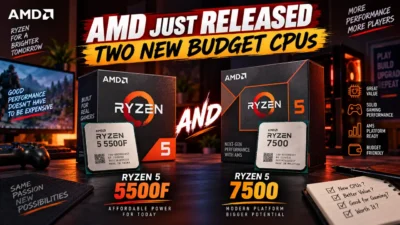
A couple of stories that already got the full write-up treatment this week: AMD quietly launched two new budget CPUs, the Ryzen 5 5500F for AM4 and Ryzen 5 7500 for AM5, explicitly framed as a response to how brutal RAM pricing has gotten — read our full breakdown for why the 5500F is the better buy of the two. And if your USB headset or mic mysteriously stopped working after this month’s Patch Tuesday, Microsoft’s KB5124008 update was the culprit — the fix, KB5129195, is already out, and we’ve got the full rundown on getting it installed.
That’s the week
Between GPUs getting priced out of the hobby they were built for and decade-old cards getting a second act through questionable-but-functional mods, it’s been a genuinely strange stretch for PC hardware. We’ll be back with another roundup as the next batch of stories piles up — for now, hang onto whatever GPU you’ve already got.