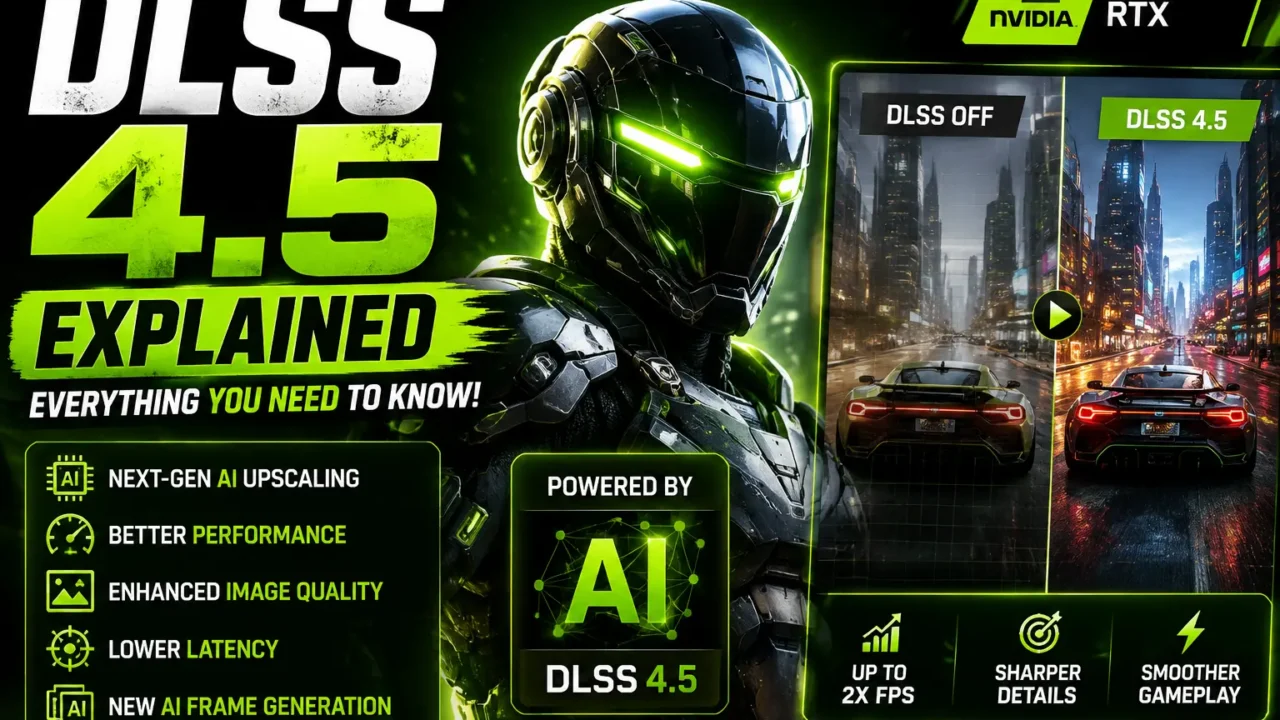
DLSS 4.5 Explained: What’s New and Why It Matters for Gamers
NVIDIA unveiled DLSS 4.5 at CES 2026, and it’s one of the more significant updates to the company’s AI rendering suite since DLSS 4 launched alongside the RTX 50 series. If you’ve seen headlines throwing around numbers like “6x frame generation” and wondered what that actually means for your setup, here’s the breakdown — including who really gets the full feature set and who doesn’t.
What DLSS Actually Does
DLSS (Deep Learning Super Sampling) uses AI to render games at a lower internal resolution and then upscale the image, aiming to match — or beat — native resolution quality while boosting frame rates. Over the years it’s expanded well beyond upscaling to include frame generation, ray reconstruction, and latency reduction through NVIDIA Reflex. DLSS 4.5 pushes all of this further, with two headline additions: a rebuilt Super Resolution model and a new take on frame generation.
The Big Changes in DLSS 4.5
Second-Generation Transformer Model DLSS 4.5 introduces a new transformer-based AI model for Super Resolution, trained on a substantially larger dataset with significantly more compute behind it than the model used in DLSS 4. In practice, this is aimed at better handling of fine detail, edges, and motion — plus improved lighting accuracy in high-contrast scenes, an area where older upscaling techniques tended to lose detail in shadows and highlights.
Dynamic Multi Frame Generation (up to 6x) This is the feature generating the most buzz. Multi Frame Generation works by having the GPU traditionally render one frame, then use AI to generate additional frames in between before the next real frame arrives. DLSS 4.5 pushes this up to a 6x multiplier — meaning for every conventionally rendered frame, up to five AI-generated frames are inserted. NVIDIA frames this as turning a 60 FPS baseline into as much as 360 FPS output.
It’s important to understand what this does and doesn’t mean: those generated frames smooth out motion on screen, but they aren’t the same as native rendering. Input responsiveness and actual simulation rate still track closer to the base frame rate, not the multiplied display number — worth knowing before you judge a game’s “feel” purely by the FPS counter.
The “Dynamic” part refers to how the system adjusts the generation multiplier automatically based on what a scene needs, rather than locking in a fixed multiplier regardless of demand — NVIDIA has compared it to an automatic transmission for your GPU.
Who Actually Gets DLSS 4.5?
This is the part that trips a lot of people up, because DLSS 4.5 isn’t one single upgrade — it’s two separate feature sets with very different hardware requirements:
| Feature | RTX 20/30/40 Series | RTX 50 Series |
|---|---|---|
| Improved Super Resolution (2nd-gen transformer) | ✅ Supported | ✅ Supported |
| Ray Reconstruction & DLAA | ✅ Supported | ✅ Supported |
| Standard Frame Generation | RTX 40 only | ✅ Supported |
| Dynamic 6x Multi Frame Generation | ❌ Not supported | ✅ Supported |
The improved upscaling model benefits every RTX generation. But the headline 6x Dynamic Multi Frame Generation feature requires the hardware flip-metering built into RTX 50-series “Blackwell” GPUs, so it isn’t coming to older cards regardless of driver updates.
Rollout Timelinel;
DLSS 4.5 arrived in two phases rather than all at once:
- January 14, 2026 — Super Resolution improvements went live via the NVIDIA app, available across supported GeForce RTX generations.
- March 31, 2026 — Dynamic Multi Frame Generation and the 6x mode arrived, exclusive to RTX 50-series cards and compatible titles.
How to Enable DLSS 4.5
If you’re on a supported GPU, you’ll need the latest NVIDIA app and an up-to-date Game Ready Driver. Some features are also gated behind the app’s “beta and experimental features” setting (Settings > About), so it’s worth checking there if a feature seems missing after updating.
Why It Matters
For 40-series owners, the upgraded Super Resolution model alone is worth grabbing — it’s a free image quality improvement with no downside. For 50-series owners, Dynamic Multi Frame Generation is the more transformative piece, particularly for high-refresh-rate displays and path-traced titles that would otherwise be out of reach for real-time performance.
The bigger picture: NVIDIA is increasingly leaning on AI-generated frames rather than raw rasterization gains to push performance forward. That’s a meaningful shift in how “performance” should be evaluated going forward — raw FPS numbers alone don’t tell the whole story anymore.
Have an RTX 40 or 50-series card and want help deciding whether DLSS 4.5 settings are worth enabling for your favorite games? Let us know in the comments — we’re building out per-game breakdowns next.